
Introduction
The squid is the most misunderstood ingredient on the luxury seafood table.
In inferior kitchens, handled with indifference and overcooked by even a margin of seconds, it becomes the rubbery, characterless calamari ring of mediocre restaurant menus that gives the entire species an undeserved reputation. In the hands of a cook who understands it, handled at the standard of absolute freshness that its delicate flesh demands, and cooked with the speed and confidence that its biology requires, it becomes one of the most tender, sweet, and genuinely extraordinary ingredients in the sea.
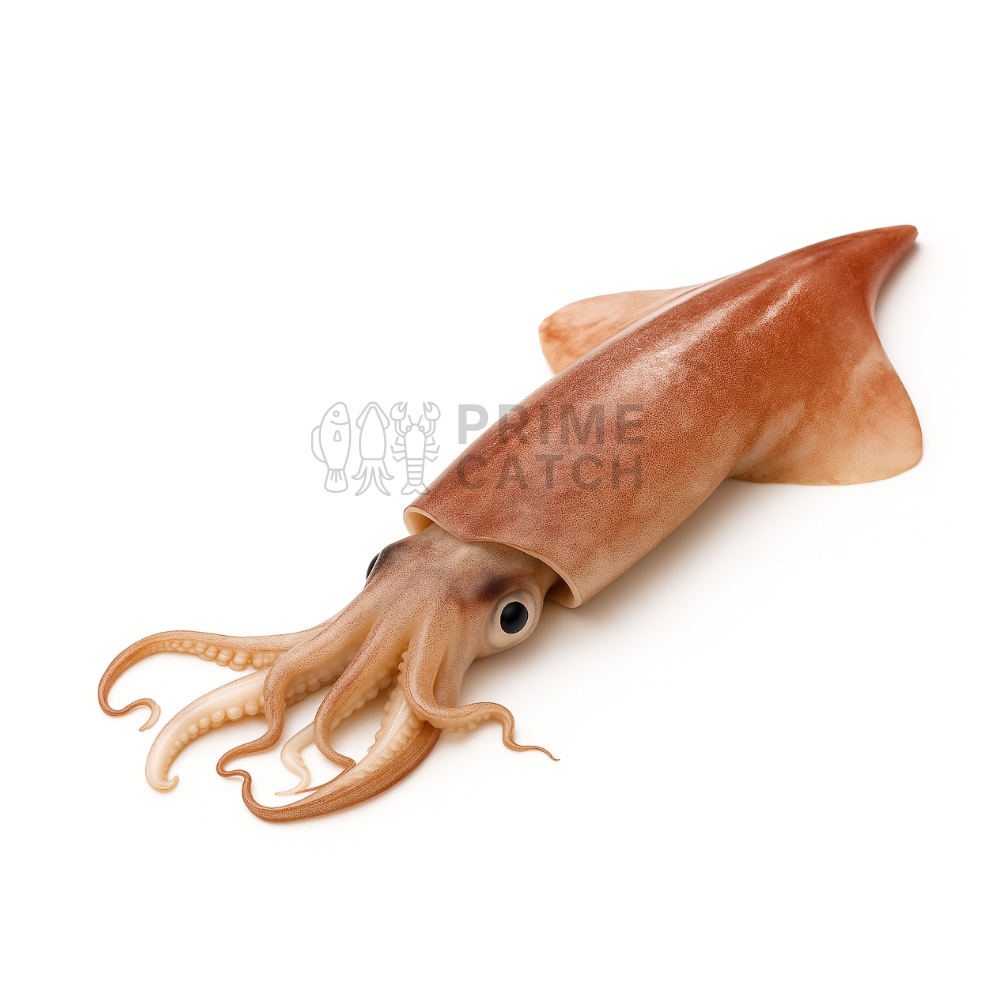
Uroteuthis duvaucelii, the Indian Squid, is the Arabian Sea’s own contribution to the world’s great squid-eating traditions. It is a species of the neritic inshore and mid-shelf waters, found throughout the Indian Ocean, the Red Sea, and the Arabian Sea at depths from a few metres to approximately 170 metres. It is an active, fast-moving, highly intelligent predator, one of the most anatomically sophisticated invertebrates in the marine world, and when it reaches the table in the condition of absolute freshness that Prime Catch delivers, it offers a flavour and texture experience that no frozen or chemically treated alternative can approximate.
At Prime Catch, we source exclusively wild-caught Indian Squid from the coastal and mid-shelf waters of the Arabian Sea, landed fresh at Karachi Fish Harbour and processed within hours of landing without chemical treatment of any kind. We offer three internationally recognised preparation formats: the whole squid for the most versatile and experienced kitchen, the cleaned skin-off calamari tube for composed preparations and charcoal grilling, and the skin-off calamari ring for the most immediately accessible and universally celebrated squid preparation in the world.
Flavour Profile
A truly fresh Indian Squid is a revelation to anyone whose only experience of the species has been with frozen or chemically preserved product.
The flesh of the mantle, the primary eating section, is white, firm, and very clean in flavour, with a mild, sweet oceanic character and a faint, mineral savouriness that speaks directly to the species’ carnivorous diet of fish, crustaceans, and smaller cephalopods in the productive waters of the Arabian Sea. There is no heaviness, no fishiness, and no intrusive aftertaste. The flavour is precise, clean, and bracingly fresh at the correct standard of handling, with a sweetness that becomes more pronounced and more satisfying as the quality of the specimen improves.
The texture is the element that divides properly handled, truly fresh squid from everything else: at the correct standard, the flesh of a fresh Indian Squid is tender, yielding, and almost silky, with a clean bite that offers minimal resistance before giving way to a moist, lightly savoury interior. This texture is available only in a genuinely fresh specimen and cannot be replicated in any frozen or preserved alternative. The moment a squid is frozen, the cellular structure of the flesh changes and the characteristic tender, yielding quality is permanently diminished. This is why Prime Catch’s fresh-only standard is of particular significance for this species above most others.
The tentacles, while less substantial than the mantle flesh, carry a more concentrated savoury flavour and a pleasantly chewier texture that makes them the preferred eating section for many who know the ingredient well. They respond particularly well to high-heat charcoal grilling, developing a caramelised, slightly crisp exterior that contrasts beautifully with the tender, savoury interior.
The ink sac, found within the mantle cavity of whole squid, contains a deeply savoury, mineral-rich ink that has been a prized ingredient in the finest European coastal cooking for centuries. In Italian, Spanish, and Portuguese culinary traditions, squid ink is used to colour and flavour pastas, risottos, and sauces with a quality of umami intensity that no other ingredient quite replicates.
Habitat
Uroteuthis duvaucelii is distributed throughout the Indo-West Pacific, from the east coast of Africa and the Red Sea across the Indian Ocean through the Arabian Sea, the Bay of Bengal, and eastward to Malaysia and the South China Sea. It is a neritic, inshore species associated with the shallow to mid-shelf coastal waters of the continental shelf, found at depths between approximately 3 and 170 metres, with the highest commercial catch densities in the nearshore and inner shelf zones.
In Pakistani waters, the species is an important and well-established component of the coastal cephalopod fishery, caught in the productive shelf waters along the Sindh and Balochistan coastlines. Research from Pakistani waters specifically references Uroteuthis (Photololigo) duvaucelii as a commercially significant species in the Arabian Sea cephalopod fishery, with studies on its growth and population dynamics conducted from catches landed at Pakistani fish harbours.
The Indian Squid is a highly active, schooling predator, moving in large aggregations through the mid-water and near-surface zones, feeding on small fish, crustaceans, and other squids including members of its own species. This active, carnivorous lifestyle in the rich, productive waters of the Arabian Sea is the direct source of the sweet, clean flavour and the firm, yielding flesh texture that makes genuinely fresh specimens so rewarding at the table.
The species responds strongly to the seasonal monsoon productivity cycle of the Arabian Sea, with peak catch abundance during the post-monsoon season when the cooling of surface waters and the associated increase in planktonic productivity draws the squid’s prey species into concentrated, accessible zones.
Taxonomy
| Classification Level | Detail |
|---|---|
| FAO Name | Indian Squid |
| Scientific Name | Uroteuthis (Photololigo) duvaucelii (d’Orbigny, 1835) |
| Common Names | Indian Squid, Indian Calamari, Duvaucel’s Squid |
| Phylum | Mollusca |
| Class | Cephalopoda |
| Order | Myopsida |
| Family | Loliginidae |
| Genus | Uroteuthis |
| Subgenus | Photololigo |
| Species | duvaucelii |
| IUCN Status | Not Evaluated |
Uroteuthis duvaucelii was formally described by the French naturalist Alcide Dessalines d’Orbigny in 1835. The species name honours Charles Marie Duvaucel, a French naturalist and collector who gathered specimens from the Indian Ocean during the early nineteenth century. It belongs to the family Loliginidae, the inshore or neritic squids, a family of cephalopods of extraordinary commercial and culinary significance worldwide, whose members include the European common squid, the Japanese common squid, and the California market squid. Unlike fish, the Indian Squid belongs to the phylum Mollusca, the molluscs, making it a closer relative of the octopus, the nautilus, and the cuttlefish than of any fish in the Prime Catch portfolio.
Physical Attributes
| Attribute | Detail |
|---|---|
| Body Form | Elongated, torpedo-shaped mantle (body) with two broad, triangular fins extending approximately half the mantle length, giving a characteristic arrow-like profile |
| Maximum Mantle Length | 40 cm (male); 23.5 cm (female) |
| Common Mantle Length | 12 to 25 cm |
| Arms and Tentacles | Eight arms and two longer feeding tentacles, all equipped with suckers for capturing prey |
| Skin Colour | Pinkish-grey to translucent white, with chromatophore pigment cells capable of rapid colour change |
| Flesh Colour (raw, skin-off) | Pure bright white to ivory, clean and translucent |
| Flesh Colour (cooked) | Opaque white, firm and moist when correctly cooked |
| Ink Sac | Present within the mantle cavity of whole squid, containing deeply savoury black ink used in classical culinary preparations |
| Gladius (Pen) | A transparent internal shell running the length of the mantle, removed in tube and ring preparations |
| Texture (raw) | Tender, fine-grained, and very moist with a clean, yielding structure |
| Texture (cooked) | Tender and silky when correctly cooked briefly at high heat; progressively firmer and tougher with extended cooking |
| Fat Content | Very low, an exceptionally lean cephalopod protein source |
| Freshness Indicator | Vivid, iridescent skin colouration, bright eyes, firm mantle, and the clean, fresh sea smell entirely absent in preserved or improperly handled specimens |
| Available Preparations | Whole · Calamari Tubes (Skin-Off) · Calamari Rings (Skin-Off) |
Preparation Formats
Prime Catch offers the Indian Squid in three internationally recognised preparation formats, each suited to a different kitchen context and culinary application:
Whole — The squid as landed from the Arabian Sea: complete, intact, and entirely unprocessed, with the mantle, tentacles, fins, ink sac, and gladius all present. The Whole format is for the experienced cook who wishes to use every element of the animal, from the tentacles to the ink sac, and who prefers to begin preparation from the most pristine and versatile possible starting point. The vivid skin colouration, the firmness of the mantle under pressure, and the brightness of the eyes are all freshness indicators immediately assessable in this format.
Calamari Tubes, Skin-Off — The cleaned mantle of the squid, with the head, tentacles, gladius (internal shell), viscera, and skin all removed, leaving a clean, smooth, ivory-white tube of pure mantle flesh. This is the globally standard preparation format for squid in professional kitchens and is known in the international seafood trade as the calamari tube, from the Italian calamaro, the universally recognised culinary name for the squid family. The tube format is the most versatile preparation for composed dishes, allowing the cook to use the mantle whole for stuffing, sliced lengthways for scored preparations, or cross-cut into rings. It is the format used by the finest seafood restaurants worldwide for grilled, pan-seared, and composed calamari preparations.
Calamari Rings, Skin-Off — The cleaned mantle cross-cut into uniform circular rings of consistent thickness, skin removed. This is the most immediately recognisable and most universally celebrated squid preparation in the world of fine dining and casual luxury alike, present on the menus of the finest coastal restaurants from Lisbon to Tokyo to Sydney. The Ring format is the most accessible, most convenient, and most directly cook-ready preparation we offer: no further preparation is required beyond the chosen cooking method. Each ring presents the characteristic ivory-white interior of a fresh, skin-off mantle in a clean, symmetrical, visually pleasing format suited to any plate.
Cooking Preferences — International Fine Dining
The Indian Squid is one of the most internationally versatile luxury seafood ingredients available, present in a celebrated preparation in virtually every great coastal culinary tradition in the world. The single most important rule governing all of them is the same: cook it fast, or cook it very long. Everything in between produces the rubbery result that has unfairly tarnished the squid’s reputation in lesser kitchens.
Europe — Calamari Fritti, Grilled and Ink-Dressed: European coastal culinary tradition has produced some of the world’s most celebrated squid preparations, and they share a commitment to simplicity and high quality of ingredient as their founding principle. Calamari fritti, in which rings or tubes are dusted in seasoned flour or a light batter and fried in clean oil at high temperature for sixty to ninety seconds, is the most universally beloved expression of this ingredient across the Mediterranean arc. The result, with a fresh Indian Squid of Prime Catch’s quality, is a revelation: a gossamer-thin, golden exterior encasing a tender, sweet, barely-set interior of extraordinary delicacy. Whole squid scored and grilled over live coals with olive oil, sea salt, and lemon is the Spanish and Portuguese tradition at its most honest. Squid ink risotto and squid ink pasta, in which the ink from the whole squid’s sac colours and flavours the dish with a deep, savoury, mineral intensity, are preparations of considerable sophistication found on the finest restaurant menus from Venice to Barcelona.
The Americas — Grilled, Ceviche-Cured and Tempura: Across North and South American fine dining, the squid is celebrated for its versatility across preparations of very different character. Whole squid or tubes, brushed with citrus and herb oil and grilled over live hardwood charcoal, produce a preparation of clean, smoky flavour and satisfying char. Latin American ceviche of thinly sliced raw tube, cured briefly in fresh lime with chilli and coriander, showcases the clean, sweet flavour of a genuinely fresh specimen with considerable elegance. Stuffed squid tubes, filled with a rice, herb, and seafood mixture and braised slowly in a rich tomato sauce, represent the long, slow alternative to the quick-cook tradition and produce a dish of deep, satisfying complexity.
East Asia — Stir-Fried, Grilled and Raw: East Asian culinary philosophy approaches the squid with the same precision it applies to every ingredient: speed, high heat, and the minimum possible interference with the natural flavour of a fresh specimen. Wok stir-frying of scored tubes or rings with garlic, ginger, and spring onion at maximum heat for sixty to ninety seconds produces a dish of clean, vivid flavour and perfect textural contrast between the lightly caramelised exterior and the tender interior. Salt and pepper squid, one of the most celebrated preparations in the Cantonese repertoire, achieves a crisp, aromatic coating over a barely-set interior that is entirely dependent on the quality of a fresh, never-frozen specimen. In Japanese preparations, the finest whole squid is served raw as sashimi or as part of an omakase course, its translucent flesh and clean, sweet flavour considered the clearest possible expression of the ingredient’s quality.
South and Southeast Asia — Sambal, Masala and Live-Fire: Across the coastal traditions of South and Southeast Asia, the squid is a beloved daily luxury of the serious seafood household. Malaysian and Indonesian sambal squid preparations, in which rings or tubes are tossed in a bold, spiced chilli paste with shallots and fresh aromatics, produce a dish of extraordinary flavour intensity that the squid’s clean, lean flesh carries with complete authority. South Indian masala preparations with fresh coconut, curry leaf, and mustard seed are equally celebrated. Whole squid grilled over live coals with a turmeric and chilli marinade, the tentacles crisping and charring at the edges while the mantle remains tender within, is a preparation of genuine coastal character found at the finest beachside seafood restaurants across the region.
The Middle East and Mediterranean — Charcoal-Grilled, Stuffed and Ink-Based: Across the Arabian Gulf and the broader Middle Eastern seafood table, the squid holds a familiar and well-regarded place in the luxury seafood spread. Whole grilling over charcoal with za’atar, olive oil, and preserved lemon produces a preparation of clean, aromatic elegance that the fresh mantle carries beautifully. Stuffed squid tubes, filled with spiced rice, fresh herbs, and pine nuts and baked in a tomato and saffron broth, represent the most elaborate and most culturally resonant expression of this ingredient across the broader Mediterranean-Middle Eastern arc.
General Guidance for Home Preparation: The single most important principle in cooking fresh squid is decisiveness. Choose one of two approaches and commit to it entirely: very fast over very high heat, one to two minutes maximum for rings and tubes, two to three minutes maximum for whole squid, or very slow over very low heat, forty-five minutes to one hour in a braise or sauce. The middle ground produces the rubbery result. For the quick method, ensure the pan, grill, or oil is at maximum temperature before the squid makes contact. Pat the preparation completely dry before cooking: any surface moisture will steam rather than sear the flesh and the result will be irreparably compromised. Season after cooking, not before. Salt draws moisture and moisture is the enemy of the sear this ingredient demands.
Health Benefits
The Indian Squid presents a nutritional profile of exceptional clinical value, combining extraordinary lean protein density with a micronutrient profile that includes some of the most bioavailable forms of several clinically significant minerals.
High-Quality Complete Protein — Exceptionally Lean and Efficient The Indian Squid delivers approximately 15 to 18 grams of complete protein per 100 grams of edible flesh at a caloric density that is among the lowest of any animal protein source in any culinary tradition. It contains all nine essential amino acids in optimal biological ratios and is essentially negligible in total fat, making it one of the most calorically efficient luxury protein sources available anywhere. Reference: WebMD — Health Benefits of Squid
Omega-3 Fatty Acids — Cardiovascular and Cognitive Protection Despite its very low overall fat content, the Indian Squid provides meaningful concentrations of EPA and DHA omega-3 fatty acids as a proportion of its total lipid content, contributing to cardiovascular protection, systemic inflammation reduction, and neurological health maintenance. Reference: Harvard Health Publishing — Omega-3 Fatty Acids: An Essential Contribution
Vitamin B12 — Among the Richest Sources Available Cephalopods are among the most concentrated whole-food dietary sources of Vitamin B12 available, and the Indian Squid is particularly rich in this critical nutrient. A standard serving provides well above the recommended daily intake for Vitamin B12, essential for neurological function, red blood cell formation, and DNA synthesis. Reference: Mayo Clinic — Vitamin B12
Selenium — Antioxidant Defence and Thyroid Support The Indian Squid is a very significant dietary source of selenium, the trace mineral essential for oxidative free radical neutralisation, immune system regulation, and thyroid hormone synthesis. A standard serving provides a clinically substantial proportion of the recommended daily intake, making it one of the most selenium-rich foods available in any culinary tradition. Reference: Mayo Clinic — Selenium
Copper — Iron Metabolism and Neurological Health Cephalopods are among the most concentrated whole-food dietary sources of copper available, an essential trace mineral involved in iron metabolism, neurological function, connective tissue formation, and antioxidant enzyme activity. The Indian Squid’s copper content is of genuine clinical significance for individuals managing iron absorption or neurological health. Reference: Harvard Health Publishing — Important Minerals
Phosphorus — Bone Mineralisation and Cellular Energy The Indian Squid is a concentrated source of phosphorus, the mineral second only to calcium in bone and dental mineralisation and essential for cellular energy metabolism through its central role in ATP synthesis. Reference: Harvard Health Publishing — Phosphorus in Your Diet
Exceptionally Low in Fat and Calories — Precision Nutrition The Indian Squid is one of the leanest animal proteins available in any culinary tradition, essentially negligible in saturated fat and very modest in total caloric density. It is one of the most consistently recommended seafood choices by clinical dietitians for individuals managing cardiovascular health, body composition, and metabolic conditions. Reference: Mayo Clinic — Dietary Fats
A Note on Prime Catch Standards
Every Indian Squid bearing the Prime Catch name is:
- Wild-caught from the coastal and mid-shelf waters of the Arabian Sea
- Fresh, never frozen — the single most important quality standard for this species, whose textural integrity is irreversibly compromised by freezing
- Chemical-free — zero preservative treatment of any kind
- Processed within hours of landing at Karachi Fish Harbour, reflecting the species’ perishability and the precision our handling protocols require
- Available in three internationally recognised formats — Whole, Calamari Tubes (Skin-Off), and Calamari Rings (Skin-Off)
- Priced per kilogram across all formats
Prime Catch. For those who accept no substitution.
Reviews
There are no reviews yet.