
Introduction
If the Orange Mud Crab is the crab of occasion, the Blue Swimming Crab is the crab of genuine daily pleasure.
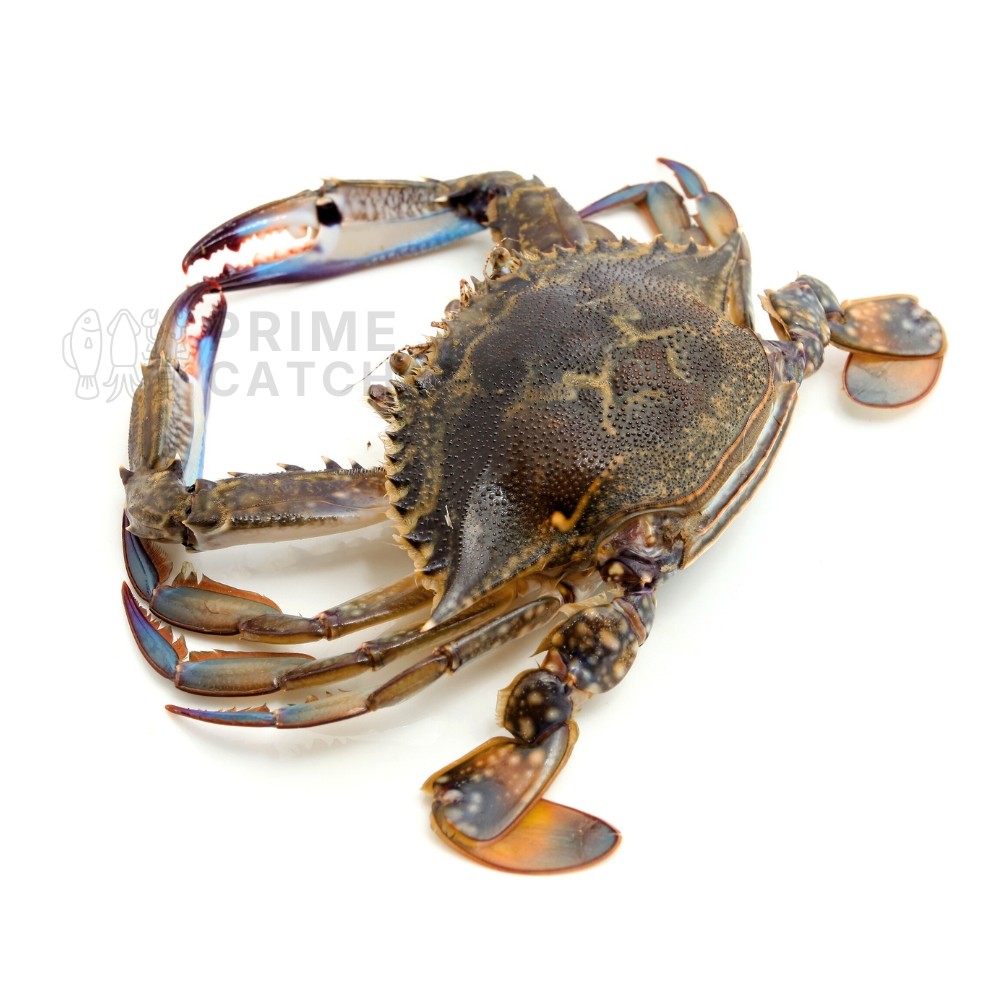
Portunus segnis is one of the most beautiful crustaceans in the Arabian Sea, immediately recognisable by the vivid blue colouration of its carapace and claws, its long, elegant lateral spines, and the distinctive paddle-shaped rear legs that make it one of the few true swimming crabs in the world, capable of moving freely through the water column rather than simply crawling along the seafloor. It is a fish of movement, of energy, and of a flavour character that reflects exactly that active, open-water lifestyle: sweet, clean, delicate, and deeply satisfying in a way that requires no occasion and no justification.
A note that Prime Catch is proud to make correctly: the crab sold throughout Pakistan’s seafood markets under the name Portunus pelagicus is not, in fact, that species. Scientific research has established that Portunus pelagicus is a Pacific species, while the genuine Blue Swimming Crab of the Arabian Sea, the Persian Gulf, and the Oman Sea coastlines is Portunus segnis, a distinct species formally described by the Danish naturalist Peter Forsskål in 1775. Most commercial and market literature in Pakistan still uses the incorrect name. Prime Catch uses the correct one, because accuracy in species identification is the foundation of everything we do.
At Prime Catch, we source exclusively wild-caught Blue Swimming Crabs from the sandy seabeds, seagrass meadows, and shallow coastal waters of the Sindh and Balochistan coastlines, where this species has been one of the most commercially significant and most frequently landed crabs for generations. At 350 to 500 grams per crab, each specimen is a large, generous, and wholly satisfying individual portion, delivered fresh, untreated, and in the condition that this delicate species specifically demands.
Flavour Profile
The Blue Swimming Crab offers a flavour experience that is distinct in character from the Orange Mud Crab and entirely its own: lighter, sweeter, more delicate, and possessed of a clean oceanic freshness that makes it one of the most universally approachable luxury crustaceans available anywhere.
The meat is white, fine-grained, and very moist, with a flavour of gentle, clean sweetness that is arguably the most purely sweet of any crab in the Arabian Sea fishery. The dominant note is a forward, fresh ocean sweetness without any of the deeper, more assertive savouriness of the Mud Crab, a direct reflection of the species’ active, open-water lifestyle and its varied diet of small fish, molluscs, and crustaceans in the clean, sandy and seagrass environments it prefers. The mid-palate is soft and delicate, carrying a subtle mineral note that confirms the marine character of the meat without ever becoming challenging. The finish is brief, clean, and refreshing.
The body meat is the most prized section: plentiful, moist, and exceptionally sweet, with a fine, yielding texture that makes it ideal for preparations where the crab meat itself is the centrepiece rather than a supporting element. The claw meat, while less abundant than in the Mud Crab, is firm and distinctly flavoured with a slightly more pronounced savouriness. The roe of a berried female Blue Swimming Crab, a deep orange mass found within the body cavity, is considered a delicacy of considerable significance in East Asian seafood culture, carrying a rich, concentrated oceanic flavour that the finest preparations incorporate with great deliberateness.
The Blue Swimming Crab is, above all, a crab for those who love the sea in its purest, most uncomplicated expression: sweet, fresh, and honest.
Habitat
Portunus segnis occupies the warm, shallow coastal and nearshore waters of the northwest Indian Ocean region, with a confirmed distribution extending from Pakistan and the northern Arabian Sea westward through the Oman Sea and Persian Gulf, and southward along the east coast of Africa to Mozambique, Madagascar, and the eastern coast of South Africa. This is distinctly the Arabian Sea species of the blue swimming crab genus, genetically and geographically separate from the Pacific Portunus pelagicus with which it was long confused.
In Pakistani waters, the species inhabits the sandy and muddy seabeds, shallow coastal bays, seagrass meadows, and nearshore sandy shelf environments of the Sindh and Balochistan coastlines, in waters typically ranging from a few metres depth to approximately 50 metres. It is found in considerable numbers along the coasts of Karachi, Sonmiani, Pasni, and Gwadar, moving actively through the water column and across the sandy substrate in pursuit of its prey.
The Blue Swimming Crab is an energetic, active predator, feeding on small fish, molluscs, bivalves, and other crustaceans with the speed and mobility that its swimming ability confers. This varied, active diet in the clean, sandy nearshore environments of the Arabian Sea is the direct source of the sweet, delicate flavour and the fine, moist meat texture that distinguishes this species from the richer, more assertive mud crab.
Taxonomy
| Classification Level | Detail |
|---|---|
| FAO Name | Blue Swimming Crab |
| Scientific Name | Portunus segnis (Forsskål, 1775) |
| Common Names | Blue Swimming Crab, Blue Swimmer Crab, Arabian Sea Blue Crab |
| Note on Nomenclature | Formerly misidentified as Portunus pelagicus in Pakistani and regional market literature; the correct species for the Arabian Sea and Persian Gulf is Portunus segnis |
| Phylum | Arthropoda |
| Subphylum | Crustacea |
| Class | Malacostraca |
| Order | Decapoda |
| Family | Portunidae |
| Genus | Portunus |
| Species | segnis |
| IUCN Status | Not Evaluated |
Portunus segnis was formally described by the Danish naturalist and explorer Peter Forsskål in 1775, and belongs to the family Portunidae, the swimming crabs, the most commercially significant family of edible crabs in the world. The family name derives from the Latin portus, meaning harbour, a reference to the coastal habitats these crabs occupy. The genus Portunus encompasses the great swimming crabs of the world’s tropical and subtropical oceans, including the celebrated Blue Crab of the Atlantic and the mud crabs of the Indo-Pacific, all prized across the world’s great seafood cultures for their sweet, fine-textured meat.
Physical Attributes
| Attribute | Detail |
|---|---|
| Body Form | Broad, hexagonal carapace with prominent lateral spines on each side, giving the classic swimming crab silhouette |
| Distinctive Feature | Rear pair of legs modified as flat, paddle-shaped swimming appendages, the defining characteristic of the swimming crab family |
| Carapace Width | Typically 12 to 16 cm at 350 to 500g |
| Market Weight | 350g to 500g per crab |
| Carapace Colour | Vivid blue to blue-green with white mottling, one of the most visually striking crustaceans in the Arabian Sea |
| Claw Colour | Bright blue with white-tipped fingers, large and well-developed |
| Meat Colour (raw) | Translucent white to pale grey |
| Meat Colour (cooked) | Clean bright white, moist and fine-grained |
| Meat Texture | Fine, moist, and yielding in the body, firmer and more structured in the claws |
| Roe | Deep orange, present in berried females, considered a premium culinary attribute |
| Meat Yield | Good, with particularly abundant and accessible body meat |
| Available Preparations | Whole Fresh · Whole Dressed |
Preparation Formats
Prime Catch offers the Blue Swimming Crab in two preparation formats, priced per kilogram:
Whole Fresh — The crab as landed from the Arabian Sea: whole, intact, and entirely unprocessed. The vivid blue carapace, the condition of the claws, and the weight relative to the size are all immediately verifiable freshness indicators in this format. Preferred by experienced cooks and professional kitchens who wish to handle the crab from the most pristine possible starting point, and particularly by those who intend to steam or boil the crab whole, the preparation that most completely preserves the natural moisture and sweetness of the meat.
Whole Dressed — The crab with the top shell (carapace) carefully removed and the gills and visceral matter cleaned, while all meat sections including the body, claw, and walking legs remain entirely intact and attached. This is the internationally standard preparation format for swimming crab in professional kitchens globally, and the format most widely used in restaurant and home cooking alike. The Dressed format exposes the body meat cavity for immediate cooking, allows marinades, sauces, and aromatics direct access to the meat, and significantly reduces the preparation time and effort required in the kitchen. The roe, where present, is retained within the body cavity in the Dressed format and contributes considerable flavour to any sauce-based or liquid-based cooking preparation.
Cooking Preferences — International Fine Dining
The Blue Swimming Crab’s sweet, delicate meat, clean flavour, and fine texture make it one of the most versatile luxury crustaceans for the serious kitchen, equally at home in the restraint of a European pasta preparation and the bold aromatics of a Southeast Asian chilli crab.
Europe — Pasta, Risotto and Bisque: European fine dining has long recognised the sweet, fine-grained meat of the swimming crab as one of the most elegant crustacean ingredients available for composed preparations. Crab linguine, in which the picked body meat is tossed with cold-pressed olive oil, fresh chilli, garlic, and lemon zest through al dente pasta, is a dish of simple, brilliant clarity built entirely on the quality of the crab. Crab risotto, finished with the creamed roe and dressed with fine herbs, is a preparation of considerable sophistication that showcases every element of the crab’s flavour in a single, composed dish. Crab bisque built on roasted Blue Swimming Crab shells produces a soup of exceptional aromatic depth and sweetness that is among the finest crustacean soups available.
The Americas — Garlic Butter, Soft Shell and Composed Plates: Across North and South American fine dining, the Blue Swimming Crab is celebrated for its abundance of sweet, accessible body meat and its suitability for the bold, aromatic preparations of the region’s great seafood tradition. Garlic butter steaming, with the dressed crab cooked in a fragrant bath of white wine, garlic, and herb butter, is a preparation of enormous popular appeal that showcases the natural sweetness of the meat with complete honesty. The Blue Swimming Crab is also the primary source of soft-shell crabs, harvested in the hours immediately following moulting when the new shell is still pliable and the entire crab is eaten whole, fried to a golden crunch in a light batter or seasoned flour.
East Asia — Steamed, Chilli Crab and Roe-Enriched Preparations: The Blue Swimming Crab holds a position of considerable prestige in East Asian seafood culture, celebrated for its sweet meat and, perhaps above all, for the roe of the female crab, which is considered one of the finest flavour-enriching elements available in the entire crustacean repertoire. Whole steaming over ginger water, finished with aged soy and sesame, is the purest possible expression of the species. The celebrated Singapore Chilli Crab tradition, originally conceived with the swimming crab, produces a dish in which the bold, spiced tomato-egg sauce is balanced by and built upon the clean sweetness of the crab meat. Roe-enriched steamed egg custard, a refined Cantonese preparation in which the crab’s orange roe is incorporated into a silken steamed egg dish, is considered one of the most elegant expressions of this ingredient in the fine dining kitchen.
South and Southeast Asia — Spiced, Coconut-Enriched and Tamarind-Braised: Across the coastal traditions of South and Southeast Asia, the Blue Swimming Crab is a beloved fixture of the everyday luxury seafood table, the crab most closely associated with the domestic festive spread and the coastal restaurant menu alike. Sri Lankan and South Indian coconut milk curries, built on whole dressed crabs simmered in a fragrant base of fresh spice, curry leaf, and coconut milk, are preparations of extraordinary regional elegance that the crab’s sweet meat carries with complete authority. Tamarind-braised preparations with dried chilli, shallots, and palm sugar produce a dish of bold, layered complexity. Thai preparations with lemongrass, galangal, and fresh green chilli showcase the crab’s delicacy in a fragrant, aromatic context of considerable sophistication.
The Middle East and Mediterranean — Spiced Butter, Grilled and Mezze-Style: Across the Arabian Gulf and the broader Middle Eastern table, the Blue Swimming Crab is a familiar and warmly regarded species at the coastal seafood restaurant and the home festive table alike. Whole dressed crabs, grilled over moderate charcoal with a za’atar and lemon butter baste, produce a preparation of aromatic simplicity that the sweet meat carries with natural elegance. Oven-roasting with preserved lemon, sumac, and herb-infused olive oil is the refined contemporary expression of the regional tradition. Simply steamed and served with warm flatbread, a garlic and lemon dipping butter, and fresh herb salad, the Blue Swimming Crab is a meal of uncomplicated and deeply satisfying luxury.
General Guidance for Home Preparation: For the Whole Fresh format, follow the same approach as the Orange Mud Crab: fifteen minutes in the freezer before dispatch renders the crab insensible and still. For the Dressed format, the crab is ready to cook immediately. Given the Blue Swimming Crab’s more delicate meat compared to the Mud Crab, slightly shorter cooking times are appropriate: a dressed crab of 350 to 500 grams requires 8 to 10 minutes over vigorously boiling, fragrant water. The meat is ready when it pulls cleanly from the shell and is set and white throughout. Do not overcook: the delicate, sweet meat of the Blue Swimming Crab loses its moisture and its defining texture very quickly beyond the correct point.
Health Benefits
The Blue Swimming Crab presents a nutritional profile of genuine clinical significance, combining exceptional lean protein quality with one of the most impressive mineral density profiles of any seafood species available at Prime Catch.
High-Quality Complete Protein — Light, Lean and Exceptionally Efficient The Blue Swimming Crab delivers approximately 17 to 21 grams of complete protein per 100 grams of edible meat, containing all nine essential amino acids in optimal biological ratios, at a very low total fat content that makes it among the most calorically efficient luxury protein sources available. Its light, lean profile makes it an ideal protein choice for those managing caloric intake without any compromise on flavour quality. Reference: WebMD — Health Benefits of Crab
Omega-3 Fatty Acids — Cardiovascular and Cognitive Support As a wild-caught marine crustacean feeding on a varied natural diet in the clean, productive coastal waters of the Arabian Sea, the Blue Swimming Crab accumulates meaningful concentrations of EPA and DHA, the long-chain omega-3 fatty acids with the strongest clinical evidence base for cardiovascular protection, inflammation reduction, and neurological health maintenance. Reference: Harvard Health Publishing — Omega-3 Fatty Acids: An Essential Contribution
Zinc — Immune Function, Wound Healing and Hormonal Health Crustaceans are among the richest dietary sources of zinc available in any whole food, and the Blue Swimming Crab is a meaningful contributor to daily zinc requirements. Zinc plays a critical role in immune system function, wound healing, protein synthesis, DNA production, and the healthy regulation of hormonal systems. Reference: Mayo Clinic — Zinc
Selenium — Antioxidant Defence and Thyroid Support The Blue Swimming Crab is a meaningful dietary source of selenium, the trace mineral essential for oxidative free radical defence, immune system regulation, and thyroid hormone synthesis, at concentrations that make a standard serving a clinically relevant dietary contribution. Reference: Mayo Clinic — Selenium
Copper — Iron Metabolism and Neurological Health As a crustacean, the Blue Swimming Crab is a significant source of dietary copper, the essential trace mineral involved in iron metabolism, neurological function, connective tissue integrity, and antioxidant enzyme activity. Reference: Harvard Health Publishing — Important Minerals
Vitamin B12 — Neurological and Haematological Health Crustaceans are among the richest whole-food sources of Vitamin B12, essential for neurological function, red blood cell formation, and DNA synthesis. The Blue Swimming Crab provides this critical nutrient at concentrations that make a standard serving a highly meaningful daily contribution. Reference: Mayo Clinic — Vitamin B12
Phosphorus — Bone Mineralisation and Cellular Energy The Blue Swimming Crab is a concentrated source of phosphorus, the mineral second only to calcium in bone and dental mineralisation and essential for cellular energy metabolism through its role in ATP synthesis. Reference: Harvard Health Publishing — Phosphorus in Your Diet
A Note on Prime Catch Standards
Every Blue Swimming Crab bearing the Prime Catch name is:
- Wild-caught from the sandy coastal shelf, seagrass meadows, and shallow bays of the Arabian Sea coastline
- Correctly identified as Portunus segnis, the genuine Arabian Sea species, distinct from the Pacific Portunus pelagicus with which it is routinely confused in the market
- Fresh, never frozen — landed at Karachi Fish Harbour and delivered within hours
- Chemical-free — zero preservative treatment of any kind
- 350 to 500 grams per crab — large, generous specimens selected for both portion size and flavour development
- Available in two formats — Whole Fresh and Whole Dressed, to suit every kitchen and every level of preparation preference
- Priced per kilogram across both formats
Prime Catch. For those who accept no substitution.
Reviews
There are no reviews yet.