
Introduction
In the world of premium seafood, very few fish carry the cultural weight, the culinary prestige, and the sheer physical authority of the Yellowfin Tuna.
Thunnus albacares is the tuna that built the global sashimi trade, that filled the finest fish markets in Tokyo, Dubai, and New York, and that continues to command some of the highest per-kilogram prices of any fish landed anywhere in the world. At Prime Catch, we source exclusively wild-caught Yellowfin Tuna from the deep, offshore waters of the Arabian Sea, where longline and handline vessels operating out of Gwadar, Ormara, and Pasni bring in specimens of exceptional quality from some of the most productive tuna-fishing grounds in the Indian Ocean.
The Arabian Sea Yellowfin is not an afterthought in the global tuna story. It is an active participant in it. The same Indian Ocean stock that supplies the finest fish markets in the Gulf and East Asia passes through these waters, and the specimens landed here, handled correctly from the moment of capture, are entirely comparable in eating quality to the tuna commanding premium prices at Tsukiji or Deira.
At Prime Catch, we handle each fish with the care that its market position demands: bled and iced immediately at sea, transported in controlled-temperature conditions, and processed in our facility within hours of landing. The result is a fish of genuine sashimi-grade integrity, available to our clients in a full range of internationally recognised preparation formats from whole round to boneless steaks.
This is the tuna the world pays a premium for. Prime Catch simply brings it to Karachi.
Flavour Profile
The Yellowfin Tuna offers a flavour profile that has made it the default luxury tuna of the global fine dining world, and the entry point through which most of the world’s most discerning seafood clients first encountered the raw fish tradition.
The flesh is a deep, rich coral-red in its finest cuts, fading to a pale pink at the mid-section, with a flavour of clean, meaty oceanic depth that is neither overpowering nor delicate. It sits confidently between the mild, buttery character of the pomfret and the intense, fatty richness of bluefin tuna, occupying a position of considerable versatility that has made it the workhorse of sashimi counters and fine dining kitchens on every continent. The dominant flavour note is a clean, savoury meatiness with a faint oceanic sweetness that becomes more pronounced in properly rested, lightly handled specimens. There is very little fat in the lean cuts, giving the flesh a clean, precise flavour without any heaviness.
The belly section, known in Japanese culinary tradition as toro, is where the fat concentrates, producing a rich, buttery, melt-in-the-mouth quality that is among the most sought-after eating experiences in the world of raw fish. In cooked preparations, the belly fat renders beautifully, basting the surrounding flesh in a self-generated richness that requires no additional fat or sauce.
The texture of the Yellowfin varies considerably by cut: the lean loin and steak sections are firm, dense, and cleanly slicing, with a fine grain that holds together impeccably under both raw preparation and high-heat cooking. The belly is notably softer and more yielding, with a fatty richness that rewards the very gentlest of heat treatments. All sections benefit from precise, careful handling from the moment the fish is landed, and it is precisely this handling that Prime Catch’s protocols are designed to protect.
Habitat
Thunnus albacares is one of the most widely distributed pelagic fish in the world’s tropical and subtropical oceans, found in all three major ocean basins and absent only from the Mediterranean Sea. The species is a highly migratory, oceanodromous apex predator, capable of crossing entire ocean basins in the course of its annual migrations, and it is this mobility that places the Arabian Sea firmly within the range of the Indian Ocean’s single, well-mixed Yellowfin Tuna population.
In Pakistani waters, Yellowfin Tuna is caught in the deep offshore zones well beyond the continental shelf, in the warm, oxygen-rich epipelagic waters of the Arabian Sea at depths typically ranging from the surface to 250 metres. The species is associated with the thermocline layer and the productive offshore current systems of the northern Indian Ocean, feeding actively on flying squid, swimming crabs, cigarfish, and flyingfish that characterise the Arabian Sea’s mid-water food chain. This diverse, high-energy diet of fast-moving oceanic prey is the direct source of the firm muscle density, rich colour, and complex flavour depth that defines Arabian Sea Yellowfin at its finest.
The species is caught here using longline and handline techniques, the same selective gear methods used by the finest tuna fisheries in the world, targeting large, mature individuals with minimal bycatch and maximum care for the quality of each fish landed.
Taxonomy
| Classification Level | Detail |
|---|---|
| FAO Name | Yellowfin Tuna |
| Scientific Name | Thunnus albacares (Bonnaterre, 1788) |
| Common Names | Yellowfin Tuna, Ahi Tuna, Allison Tuna |
| Phylum | Chordata |
| Class | Actinopterygii |
| Order | Scombriformes |
| Family | Scombridae |
| Genus | Thunnus |
| Species | albacares |
| FAO Species Code | YFT |
| IUCN Status | Least Concern |
Thunnus albacares was first formally described by the French naturalist Pierre Joseph Bonnaterre in 1788. The genus name Thunnus derives from the Greek thynnos, meaning tunna, while the species name albacares references the fish’s distinctive colouration. The species is also widely known by the Hawaiian name Ahi, a term that has entered the global fine dining vocabulary as the standard reference for Yellowfin in premium raw preparations. It belongs to the Scombridae family, the mackerels and tunas, one of the most commercially significant fish families in the world and the source of the planet’s most widely consumed large pelagic seafood.
Physical Attributes
| Attribute | Detail |
|---|---|
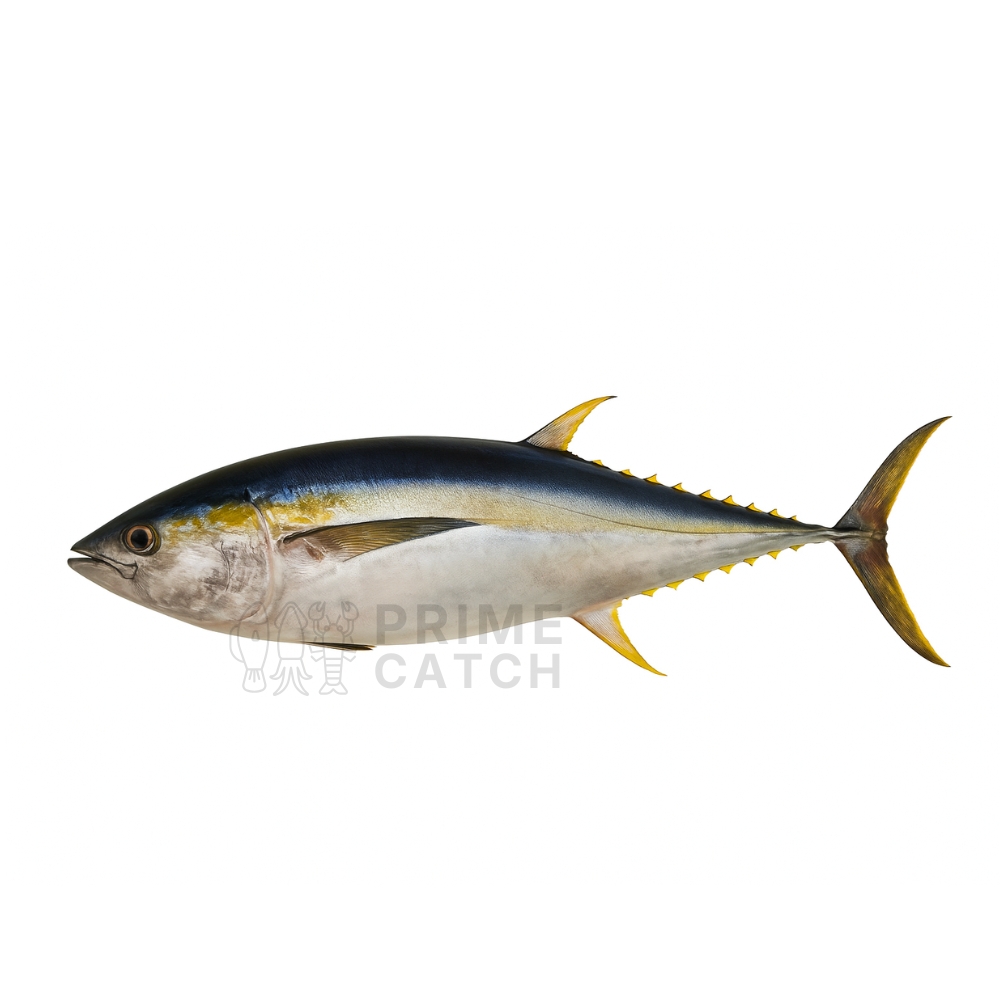
| Body Form | Large, torpedo-shaped, highly streamlined pelagic predator |
| Maximum Length | 239 cm fork length |
| Common Length | 150 cm fork length |
| Maximum Weight | 200 kg |
| Body Colour | Metallic dark blue to greenish dorsally, silver-white on belly and lower flanks with faint vertical lines |
| Distinctive Features | Bright yellow second dorsal fin, anal fin, and finlets between fins and tail; elongated scythe-shaped pectoral fins in large specimens |
| Flesh Colour, Lean Loin (raw) | Deep coral-red to rich pink, depending on section |
| Flesh Colour, Belly (raw) | Pale pink to cream with visible fat marbling |
| Flesh Colour (cooked) | Pale beige to off-white in fully cooked preparations; deliberately left rare in fine dining service |
| Texture, Lean Cuts (raw) | Firm, dense, fine-grained, cleanly slicing |
| Texture, Belly (raw) | Soft, richly fatty, yielding |
| Fat Content | Variable by section: lean in loin and steak cuts, richly fatty in the belly |
| Available Preparations | Whole Round · Whole Gutted and Cleaned Head-On · Headless Gutted and Cleaned · Loin Skin-On · Loin Skin-Off · Steak Skin-On · Steak Skin-Off · Sashimi Block |
Preparation Formats
Prime Catch offers Yellowfin Tuna in seven internationally recognised preparation formats, covering the full range from whole fish to sashimi-grade block, with skin-on and skin-off options across the portioned cuts.
Whole Round — The tuna as landed: whole, ungutted, and fully intact. Reserved for professional kitchens, experienced cooks, and buyers who require the complete fish for their own processing or large-format service. The definitive format for freshness verification, with eyes, gills, and flesh colour all immediately assessable.
Whole Gutted and Cleaned, Head-On — The fish eviscerated, cleaned, and rinsed, with head and tail fully intact. The standard format for whole-fish roasting or ceremonial large-format service. The collar and head sections of a large Yellowfin are flavourful cuts in their own right and are retained in this format.
Headless Gutted and Cleaned — Gutted, cleaned, and head-removed. A practical, manageable format that retains the full flesh body from collar to tail, preferred by kitchens processing the fish in-house into steaks, loins, or portions.
Loin, Skin-On — The four prime loins of the tuna, hand-cut along the backbone with skin intact. This is the foundational processing cut of the global tuna industry and the format from which all portioned tuna preparations originate. Skin-on loin retains the full structural integrity of the fish and allows the receiving kitchen to portion as required, with the option to skin individual pieces at the point of service.
Loin, Skin-Off — The four prime loins, fully skinned and trimmed to a clean, consistent format. Ready for immediate portioning into steaks, sashimi slices, or composed preparations without any further breakdown. The preferred format for kitchens that require a fully prepared, skin-free raw material.
Steak, Skin-On — The whole fish cross-cut into uniform transverse steaks of consistent thickness, with skin retained on the outer edge. The most widely recognised format for cooked tuna across every culinary tradition in the world. The skin-on edge caramelises beautifully under high heat, adding a flavour dimension and structural frame to the steak that skin-off preparations cannot replicate.
Steak, Skin-Off — Uniform transverse steaks, fully trimmed and skin-removed. A clean, lean format suited to searing, grilling, and any plated preparation where absolute uniformity of the portion is required. The preferred format for a composed fine dining plate where the tuna steak is presented as a standalone centrepiece.
Cooking Preferences — International Fine Dining
The Yellowfin Tuna is the single most internationally versatile luxury fish in the world of fine dining, equally celebrated raw, barely seared, grilled over live fire, and slow-roasted. Its reputation crosses every culinary culture and every cooking tradition with equal authority.
Europe — Seared, Tartare and Classically Composed: European fine dining has embraced the Yellowfin Tuna as one of its most important luxury fish over the past three decades, and the preparation most closely associated with it on the European fine dining plate is the skin-off steak or loin, seared in a smoking-hot pan for thirty to forty-five seconds per side, leaving the interior entirely raw and the exterior caramelised to a thin, savoury crust. This preparation, served sliced with a light ponzu, herb oil, or classic beurre blanc, showcases the species’ firm texture and clean flavour at their most expressive. Tuna tartare, finely hand-chopped and dressed with cold-pressed olive oil, capers, shallot, and citrus, is a fixture of the European luxury starter course. Slow-roasted whole loin with aromatic herbs is the Sunday centrepiece preparation at the finest southern European tables.
The Americas — Ahi, Poke and Live-Fire Grilling: The Yellowfin Tuna is known across North America as Ahi and occupies a position of enormous cultural and culinary significance in the premium seafood market. The blackened Ahi steak, seared over intense heat with a bold spice crust and served with a soy-ginger dressing, is one of the defining luxury fish dishes of the American restaurant tradition. Hawaiian poke, in which the raw tuna is cubed and dressed with soy, sesame, chilli, and aromatics, has become one of the most widely consumed luxury seafood preparations in the world, built entirely on the quality of a properly handled fresh Yellowfin. Latin American tiradito and ceviche preparations apply acid and aromatics to thinly sliced raw loin with extraordinary elegance.
East Asia — Sashimi, Sushi, Aburi and Tataki: The Yellowfin Tuna is the foundation of the global sashimi and sushi industry. On the omakase counter, the lean loin is sliced with precision and served with nothing but wasabi and aged soy sauce, the entire emphasis placed on the quality of the fish itself. The belly section, served as nigiri or sashimi, is among the most prized bites in the entire Japanese culinary canon. Aburi preparations, in which the surface of the fish is briefly torched, caramelise the surface fat and produce an extraordinary savoury sweetness entirely different from the raw expression. Tataki, in which the whole loin is briefly seared over live flame, sliced, and dressed with citrus and ginger, is the mainstream Japanese cooked expression of this fish at its most refined.
South and Southeast Asia — Spiced, Grilled and Coconut-Enriched: Across the coastal traditions of South and Southeast Asia, Yellowfin Tuna is a prestige catch of considerable cultural significance. Tuna steaks, marinated in fresh turmeric, chilli, and coriander, then grilled over live coals to a caramelised exterior and a deliberately rare interior, represent one of the most celebrated preparations of this fish across the region. Coconut milk curries built on tuna loin cubes, light tamarind broths, and dry-spiced pan preparations all allow the firm, meaty flesh of the Yellowfin to carry bold, aromatic seasoning with complete authority.
The Middle East and Mediterranean — Charcoal-Grilled, Za’atar-Rubbed and Mezze-Style: Across the Arabian Gulf and the broader Middle Eastern table, the Yellowfin Tuna has established itself as one of the most prestigious luxury fish at the serious seafood restaurant. Thick steaks, rubbed with za’atar, sumac, and olive oil and grilled over live charcoal to a medium-rare interior, produce a dish of considerable regional elegance. The sashimi and tartare traditions have taken root with remarkable speed at the finest Gulf restaurants, where the fish’s clean, meaty flavour and firm texture are increasingly recognised as the ideal medium for raw preparations. Cold Yellowfin carpaccio with a tahini-citrus dressing is a contemporary Middle Eastern fine dining preparation of particular distinction.
General Guidance for Home Preparation: Tuna is one of the very few fish in the world that is unambiguously superior when served rare to medium-rare rather than fully cooked. For a steak preparation, a hot, dry pan with no added fat and forty-five seconds to sixty seconds per side on each surface produces the caramelised exterior and cool, raw interior that define this fish at its finest. Season only with sea salt before cooking; everything else comes at the point of service. Do not, under any circumstances, cook Yellowfin Tuna to well-done. A fully cooked tuna steak is a different and considerably lesser dish.
Health Benefits
The Yellowfin Tuna stands among the most nutritionally significant seafood species available, combining an extraordinary lean protein density with a micronutrient profile that reads as a comprehensive catalogue of the most clinically important marine nutrients.
High-Quality Complete Protein at Exceptional Density Yellowfin Tuna delivers approximately 25 to 30 grams of complete protein per 100 grams of edible flesh, making it one of the most protein-dense whole foods available in any culinary tradition. It contains all nine essential amino acids in optimal biological ratios, and its very low fat content means this protein is delivered at a caloric efficiency that few other animal foods can match. Reference: WebMD — Health Benefits of Tuna
Omega-3 Fatty Acids — Cardiovascular and Cognitive Protection As a wild-caught, apex pelagic predator feeding on a rich marine food chain of squid, crustaceans, and pelagic fish, the Yellowfin Tuna accumulates meaningful concentrations of EPA and DHA, the long-chain omega-3 fatty acids with the most robust clinical evidence base for cardiovascular protection, systemic inflammation reduction, and neurological health maintenance. Reference: Harvard Health Publishing — Omega-3 Fatty Acids: An Essential Contribution
Vitamin B12 — Neurological and Haematological Health Yellowfin Tuna is one of the single richest dietary sources of Vitamin B12 available in any whole food. A standard 200-gram serving provides well in excess of the recommended daily intake for this vitamin, which is essential for neurological function, red blood cell formation, and DNA synthesis. Reference: Mayo Clinic — Vitamin B12
Selenium — Antioxidant Defence and Thyroid Support Large pelagic fish are among the most concentrated dietary sources of selenium available, and Yellowfin Tuna is no exception. A standard serving provides a clinically significant proportion of the recommended daily intake for this trace mineral, which is essential for oxidative free radical defence, immune system modulation, and thyroid hormone synthesis. Reference: Mayo Clinic — Selenium
Niacin (Vitamin B3) — Metabolic and Cardiovascular Health Yellowfin Tuna is an exceptional source of niacin, one of the B vitamins with the most direct and well-documented role in lipid metabolism, cardiovascular health, and cellular energy production. A single serving provides a substantial proportion of the recommended daily intake. Reference: Harvard Health Publishing — B Vitamins
Iodine — Thyroid and Metabolic Regulation As a deep-ocean pelagic species, Yellowfin Tuna accumulates dietary iodine from its natural marine environment at levels of genuine clinical significance, supporting healthy thyroid function, metabolic regulation, and neurological development. Reference: Harvard Health Publishing — Iodine Deficiency
Exceptionally Lean — Cardiovascular-Friendly Precision Nutrition Yellowfin Tuna is among the leanest large fish available, very low in total fat and essentially negligible in saturated fat. It is one of the most consistently recommended protein sources by clinical dietitians for individuals managing cardiovascular health, body composition, and metabolic conditions, precisely because it delivers exceptional protein quality at minimal caloric cost. Reference: Mayo Clinic — Dietary Fats
A Note on Prime Catch Standards
Every Yellowfin Tuna bearing the Prime Catch name is:
- Wild-caught from the Arabian Sea using longline and handline techniques
- Chemical-free with zero preservative treatment of any kind
- Available in eight preparation formats from Whole Round to Sashimi Block, with skin-on and skin-off options across all portioned cuts
- Priced per kilogram across all preparation formats
Prime Catch. For those who accept no substitution.
Reviews
There are no reviews yet.