
Introduction
Not every fish needs to borrow its prestige from another ocean.
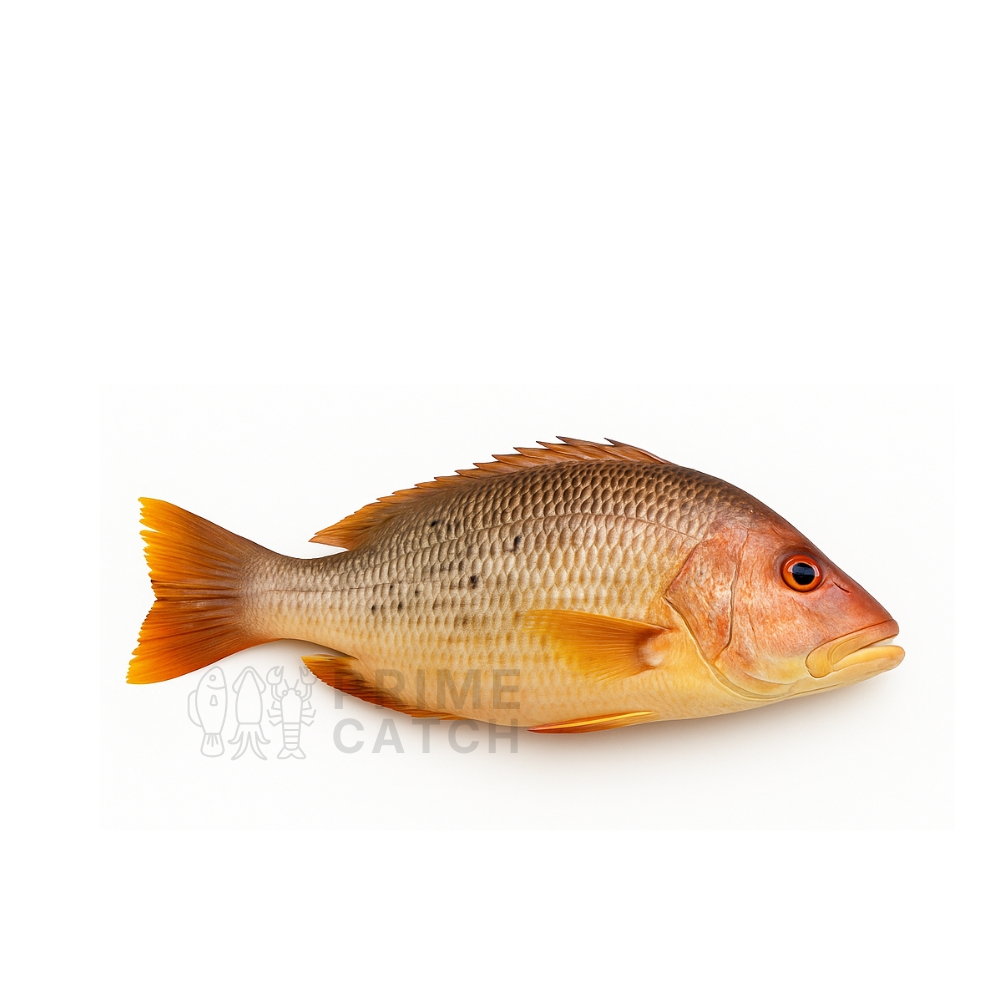
The snappers of the Arabian Sea — members of the celebrated Lutjanidae family, the same lineage that has commanded the finest seafood tables across the Indo-Pacific for centuries — are among the most flavourful, most versatile, and most visually striking fish this coastline produces. At Prime Catch, we source the wild-caught John Snapper exclusively: principally Lutjanus johnii — the John’s Snapper — and Lutjanus malabaricus — the Malabar Blood Snapper — two of the most prized members of the snapper family present in these waters, landed fresh from the reef and rocky-bottom zones of the Sindh and Balochistan coastlines.
We do not call this fish by a borrowed name. The John Snapper is not the Atlantic Red Snapper of the Gulf of Mexico — a species native to an entirely different ocean, and one not present in these waters. What we offer is something rarer and more honest: a wild snapper of genuine Indo-Pacific provenance, caught in the same Arabian Sea that has fed this coastline for millennia, handled without chemical treatment, and delivered without the compromise of freezing.
This is a fish of considerable beauty — deep-flanked, vivid in colour, and possessed of a firm, white flesh of exceptional eating quality. It requires no foreign endorsement. It needs only to be fresh. And fresh, without exception, is what Prime Catch delivers.
Flavour Profile
The John Snapper delivers a flavour experience that positions it firmly among the great eating fish of the Indo-Pacific — a profile of confident, clean richness that distinguishes the Lutjanidae family from every other reef fish in these waters.
The dominant characteristic is a firm, moist, white flesh of moderate fat content — richer and more assertive than the delicate pomfrets, yet never heavy or overbearing. The flavour is clean and distinctly oceanic, with a pleasing sweetness in the mid-palate that is characteristic of reef-dwelling carnivores feeding on a varied, natural diet of smaller fish, crustaceans, and cephalopods. The finish is savoury, lingering, and satisfying — a fish that leaves the palate asking for more rather than demanding relief.
The texture is among the finest of any Arabian Sea species: firm, dense, and structured, with a large flake that holds together beautifully through a wide range of cooking methods — from the high heat of a charcoal grill to the gentle warmth of a steamer. It is a fish that rewards both bold spicing and restrained simplicity with equal generosity, and one that retains its moisture and structural integrity under cooking conditions that would compromise a lesser species.
The skin, when crisped correctly over high heat, develops a deeply caramelised, flavour-rich exterior that adds a further dimension of complexity entirely absent in skinless preparations.
Habitat
Lutjanus johnii and Lutjanus malabaricus — the two primary species marketed under the Prime Catch John Snapper designation — inhabit the warm, tropical and subtropical waters of the Indo-West Pacific, with a combined range extending from the Persian Gulf and the Arabian Sea across the Indian subcontinent to Southeast Asia, the Pacific Islands, and the northern coasts of Australia.
In Pakistani waters, both species are associated with the reef and hard-bottom environments of the Sindh and Balochistan coastlines — rocky outcrops, coral formations, and high-relief seafloor structures at depths ranging from the shallow nearshore zone to the mid-shelf. Lutjanus malabaricus in particular favours deeper reef habitats at 12 to 100 metres, where it feeds primarily on smaller fish and benthic crustaceans — a predatory diet that contributes directly to the firm texture and savoury richness of the flesh. Lutjanus johnii is more commonly associated with shallower coastal reefs, estuarine environments, and mangrove-adjacent systems, producing a somewhat lighter, sweeter flesh profile.
Both species are carnivorous apex predators within their reef ecosystems — foraging actively on fish, crustaceans, and cephalopods — and both produce flesh of exceptional quality as a direct result of this natural, varied diet. Wild specimens from the Arabian Sea, developing in a high-energy reef environment, exhibit a flavour complexity and textural density that no aquaculture alternative can replicate.
Taxonomy
| Classification Level | Detail |
|---|---|
| FAO Name | John’s Snapper |
| Scientific Names | Lutjanus johnii (Bloch, 1792) · Lutjanus malabaricus (Bloch & Schneider, 1801) |
| Common Names | Arabian Sea Snapper, John’s Snapper, Arabian Red Snapper |
| Phylum | Chordata |
| Class | Actinopterygii |
| Order | Perciformes |
| Family | Lutjanidae |
| Genus | Lutjanus |
| FAO Species Codes | LJJ (L. johnii) · LJM (L. malabaricus) |
| IUCN Status | Least Concern |
| Origin | Arabian Sea — wild-caught |
Both species belong to the Lutjanidae — the snapper family — one of the most commercially significant and widely celebrated fish families in the Indo-Pacific world. Lutjanus johnii was formally described by the German naturalist Marcus Elieser Bloch in 1792; Lutjanus malabaricus was described jointly by Bloch and Schneider in 1801. The family name derives from the Malay ikan lutjan — a testament to the deep cultural roots of these fish in the seafood traditions of the Indo-Pacific.
Physical Attributes
| Attribute | Detail |
|---|---|
| Body Form | Deep-bodied, laterally compressed, robust — the classic snapper profile |
| Colour (live / fresh) | Vivid reddish-gold to deep crimson flanks with bronze and silver highlights — species-dependent |
| Scales | Large, firm, and strongly pigmented — producing the characteristic vivid colouration |
| Flesh Colour (raw) | Bright white to pale ivory — firm and dense |
| Flesh Colour (cooked) | Clean white, large-flaked, moist |
| Texture (raw) | Firm, structured, and dense — with a large, cohesive flake |
| Texture (cooked) | Moist, substantial, and cleanly flaking — retains structure under high heat |
| Fat Content | Moderate — richer than pomfret, leaner than salmon |
| Skin | Thick, firm, and richly pigmented — excellent for high-heat skin-on preparations |
| Eyes (freshness indicator) | Bright, clear, and convex on Prime Catch-grade specimens |
| Gills (freshness indicator) | Deep red — the primary freshness indicator |
| Available Preparations | Whole Round · Whole Gutted & Cleaned · Headless Gutted & Cleaned · Bone-In Steaks · Boneless Fillet |
Preparation Formats
Prime Catch offers the John Snapper in five internationally recognised preparation formats, priced per kilogram:
Whole Round — The fish as landed from the Arabian Sea: whole, ungutted, and entirely intact. The definitive format for freshness verification — eyes, gills, and skin immediately assessable. Preferred by professional kitchens and experienced home cooks who wish to begin preparation at the most pristine possible starting point.
Whole Gutted & Cleaned · Head-On — Eviscerated, scaled, and rinsed, with head and tail fully intact. The standard preparation for whole-fish roasting, steaming, and grilling across every serious seafood tradition in the world. The head and collar of the snapper are particularly flavour-rich and are retained in this format for that reason.
Headless Gutted & Cleaned — Gutted, cleaned, and head-removed. A clean, practical format retaining the full fillet section and tail — preferred for grilling and pan preparations where a neater presentation at the table is desired, without sacrificing any of the prime flesh.
Bone-In Steaks · Cross-Cut — The whole fish cross-cut into uniform transverse steaks — the most widely recognised and most commercially significant preparation format for snapper across South Asian, Middle Eastern, and Gulf seafood traditions. Each steak retains the skin, the central bone section, and the full flavour of the fish. The exposed cut surface produces exceptional caramelisation in shallow-frying and charcoal-grilling — the preparation that best showcases the snapper’s firm, moist flesh and richly flavoured skin.
Boneless Fillet · Skin-On — The prime fillet section, carefully hand-cut from the bone and trimmed to a clean, presentation-ready format with skin intact. The professional kitchen’s preferred format for composed plating, pan-searing, and any preparation where bone-free service is essential. The skin-on finish allows for the celebrated skin-crisp technique that defines the finest snapper preparations in European and East Asian fine dining.
Cooking Preferences — International Fine Dining
The John Snapper’s firm texture, moderate fat content, and vivid skin make it one of the most rewarding luxury fish to cook across virtually every culinary tradition — a species equally at home in the restraint of a European kitchen and the bold aromatics of a South Asian seafood table.
Europe — Skin-Crisped, Whole-Roasted & Simply Composed: In European fine dining, the snapper fillet — skin-on, pan-seared in clarified butter or cold-pressed oil at high heat until the skin is golden and crackling — is one of the most technically satisfying preparations in the kitchen repertoire. The firm flesh holds its shape impeccably under heat; the skin crisps to a deeply caramelised finish that adds a layer of savoury complexity absent in any skinless preparation. Whole-roasted with cold-pressed olive oil, fresh herbs, and sea salt, the snapper presents magnificently at the table — vivid, aromatic, and requiring no further embellishment. Beurre blanc and light herb emulsions are the classical European accompaniments.
The Americas — Grilled, Citrus-Cured & Live-Fire: Across North and South America, the snapper — firm-fleshed, skin-on, grilled over live hardwood charcoal — is one of the defining luxury fish preparations of the coastal fine dining tradition. Scored deeply, marinated in citrus, fresh herbs, and chilli, then grilled to a crackling, caramelised exterior over live coals: the firm flesh of the John Snapper handles this preparation with complete authority. In Latin American fine dining, snapper ceviche and tiradito — thinly sliced raw fillet dressed in fresh citrus, chilli, and aromatic oils — are preparations of considerable elegance that speak directly to the quality of a truly fresh, chemical-free specimen.
East Asia — Steamed Whole, Wok-Finished & Crispy Skin: The snapper is one of the most celebrated whole-steaming fish across East Asian culinary tradition — prized for its firm flesh, large flake, and the rich flavour of its head and collar. Whole steaming over ginger-infused water, finished with cascading hot oil, julienned aromatics, and aged soy sauce, is a preparation of extraordinary elegance when the base ingredient is of Prime Catch’s freshness standard. The boneless fillet, skin-crisped in a screaming-hot wok and served with a light ginger-soy dressing, is the contemporary fine dining expression of the same tradition. Deep-fried whole — a preparation reserved for the finest specimens — produces a dramatic, golden presentation of considerable cultural resonance across the region.
South & Southeast Asia — Spiced, Fried & Coconut-Enriched: Across the coastal traditions of South and Southeast Asia, the snapper is the prestige reef fish of the celebratory table — the species most associated with hospitality of the highest order. Whole shallow-frying in cold-pressed oil, scored and marinated in turmeric, chilli, and coriander, produces a golden, spiced crust of considerable beauty enclosing moist, sweet white flesh. Bone-in steaks, fried to a deep golden crust and served alongside aromatic rice, represent one of the most beloved preparations of this fish across the region. The boneless fillet, marinated in a green herb paste and grilled over coconut husk, is a preparation found on the finest coastal restaurant menus from Colombo to Penang.
The Middle East & Mediterranean — Charcoal-Grilled, Whole-Presented & Spiced: Across the Arabian Gulf and the broader Middle Eastern seafood tradition, the snapper holds a position of deep cultural familiarity and considerable prestige. Whole charcoal-grilling — scored, marinated in cumin, dried lemon, sumac, and olive oil, then grilled over live coals until the skin chars and crisps — is the dominant celebration preparation of this fish across the region. Bone-in steaks, shallow-fried in spiced oil and served alongside machboos-style rice and a herb salad, represent the most domestically beloved format. The boneless fillet, oven-roasted with za’atar, pomegranate molasses, and preserved lemon, is the refined contemporary expression of the regional tradition at its most elevated.
General Guidance for Home Preparation: Score whole fish deeply before cooking — three to four diagonal cuts per side — for even heat penetration and maximum marinade absorption. For bone-in steaks, a hot, well-oiled pan and 4–5 minutes per side produces the caramelised crust this cut demands. For boneless fillets, always cook skin-side down first for 70–80% of the total time — the skin is not merely a cooking surface but a flavour component of considerable value. Do not overcook: the flesh should flake cleanly but retain its moisture throughout.
Health Benefits
The John Snapper presents a nutritional profile of genuine clinical significance — combining high-quality complete protein, essential marine micronutrients, and a moderate fat content that delivers meaningful omega-3 concentrations without the caloric density of the richest fish species.
High-Quality Complete Protein — Substantial & Satisfying The John Snapper delivers approximately 20–26g of complete protein per 100g of edible flesh — all nine essential amino acids present in optimal biological ratios, in a format that is as satiating as it is nutritionally complete. Its moderate fat content gives it a richness of flavour and staying power that purely lean fish species cannot match. Reference: WebMD — Health Benefits of Fish
Omega-3 Fatty Acids — Cardiovascular & Cognitive Protection As a wild-caught, reef-dwelling carnivore feeding on a varied natural diet of fish, crustaceans, and cephalopods, the John Snapper accumulates meaningful concentrations of EPA and DHA — the long-chain omega-3 fatty acids with the most robust clinical evidence base for cardiovascular protection, systemic inflammation reduction, and neurological health maintenance. Reference: Harvard Health Publishing — Omega-3 Fatty Acids: An Essential Contribution
Selenium — Antioxidant Defence & Thyroid Support The snapper is a meaningful dietary source of selenium — the trace mineral essential for oxidative free radical neutralisation, immune system modulation, and thyroid hormone synthesis. A standard serving provides a clinically significant proportion of the recommended daily intake. Reference: Mayo Clinic — Selenium
Phosphorus — Bone Mineralisation & Cellular Energy The John Snapper is a concentrated source of phosphorus — the mineral second only to calcium in bone and dental mineralisation, and essential for cellular energy metabolism through its central role in ATP synthesis. Reference: Harvard Health Publishing — Phosphorus in Your Diet
Vitamin D — The Marine Sunshine Nutrient Reef-dwelling carnivorous fish are among the most significant whole-food sources of Vitamin D — the fat-soluble vitamin essential for calcium absorption, bone density, immune function, and mood regulation, and broadly deficient in the diets of urban populations with limited sun exposure. Reference: Harvard Health Publishing — Vitamin D and Your Health
Iodine — Thyroid & Metabolic Regulation As a wild marine species, the John Snapper accumulates dietary iodine from its natural reef environment at levels of genuine clinical significance — supporting healthy thyroid function, metabolic regulation, and neurological development in ways that inland protein sources structurally cannot provide. Reference: Harvard Health Publishing — Iodine Deficiency
Vitamin B12 — Neurological & Haematological Health Marine fish are among the richest whole-food sources of Vitamin B12 — essential for neurological function, red blood cell formation, and DNA synthesis. The John Snapper provides this critical nutrient at concentrations that make a standard serving a meaningful daily contribution. Reference: Mayo Clinic — Vitamin B12
A Note on Prime Catch Standards
Every John Snapper bearing the Prime Catch name is:
- Wild-caught from the Arabian Sea — a fish of genuine reef-origin provenance, not a borrowed name from another ocean
- Fresh, never frozen — landed at Karachi Fish Harbour and delivered within hours
- Chemical-free — zero preservative treatment of any kind
- Correctly identified — principally Lutjanus johnii and Lutjanus malabaricus, the Indo-Pacific snappers native to these waters
- Available in five preparation formats — from Whole Round to Boneless Fillet — to suit every kitchen and every occasion
- Priced per kilogram — across all preparation formats
Prime Catch. For those who accept no substitution.
Reviews
There are no reviews yet.