
Introduction
There are fish that feed a nation — and then there are fish that define one.
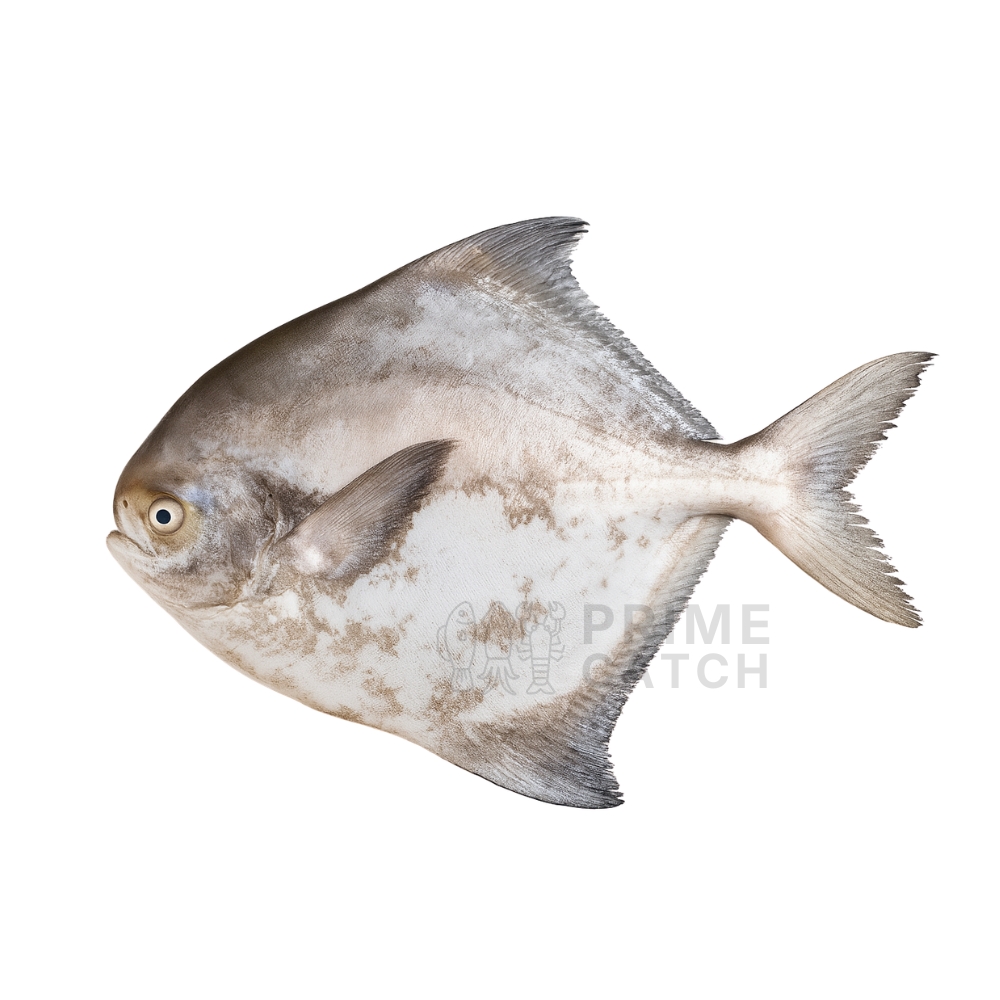
The Chinese Silver Pomfret holds a position in the culinary heritage of the Arabian Sea coastline that no other species can claim. Pampus chinensis — flat-bodied, silver-scaled, and possessed of a white flesh of uncommon delicacy — has been the centrepiece of the finest seafood tables from Karachi to Muscat to Hong Kong for centuries. It is the fish that discerning households request by name, that experienced cooks handle with reverence, and that serious seafood markets reserve for their most valued clientele.
At Prime Catch, we source exclusively from wild-caught Arabian Sea stocks — the same waters that have produced the finest pomfret specimens in the world. Our Chinese Silver Pomfret is landed fresh at Karachi Fish Harbour, handled without chemical treatment, and delivered without the compromise of freezing. It arrives as the sea intended it: bright-eyed, silver-flanked, and in a condition of absolute freshness that the species’ delicate flesh demands above all else.
Available in four internationally recognised preparation formats to suit every kitchen and every occasion, Prime Catch’s Chinese Silver Pomfret is the Arabian Sea at its most refined — offered, without apology, to those who know the difference.
Flavour Profile
The Chinese Silver Pomfret is defined by a quality that is, in fine food, rarer than intensity: purity.
The flesh is white, fine-grained, and lean — with a flavour of exceptional clarity that registers as clean, sweet, and softly oceanic on the palate. There is no heaviness, no oiliness, no assertive brininess. Instead, a delicate marine sweetness that occupies the mid-palate with remarkable elegance and a finish that is clean, brief, and entirely without bitterness.
This purity of flavour makes the Chinese Silver Pomfret one of the most rewarding fish to cook with restraint — where the ingredient, rather than the preparation, does the speaking. It also makes it acutely unforgiving of compromise: chemical preservatives, prior freezing, or mishandling destroy the very quality that elevates this species above all others in its class. A fresh specimen, correctly handled, is revelatory. An inferior one is ordinary. There is very little middle ground.
The texture of the cooked flesh is exceptionally fine — tender, moist, and gently flaking in clean, white segments along the natural bone line. It holds its moisture well under moderate heat, producing a finished dish of considerable succulence when not overcooked.
Habitat
Pampus chinensis inhabits the warm, shallow coastal and continental shelf waters of the Indo-West Pacific — ranging from the Persian Gulf and the Arabian Sea across the Indian subcontinent to the South China Sea and the waters of Southeast Asia. In Pakistan, the species is most densely concentrated in the nearshore and mid-shelf zones of the Sindh and Balochistan coastlines, where the seasonal productivity of the Arabian Sea — driven by monsoon-induced upwelling — supports the rich invertebrate and plankton communities on which the pomfret feeds.
The species favours sandy and muddy substrates at moderate depths, where it forages on small crustaceans, jellyfish, and zooplankton — a diet that contributes directly to the sweetness and delicacy of its flesh. Wild specimens from the Arabian Sea, developing in a nutrient-rich open-ocean environment, exhibit a flavour complexity and textural quality that aquaculture cannot replicate.
The Chinese Silver Pomfret is one of the most commercially significant fish species in the Arabian Sea fishery and has been a staple of the Karachi Fish Harbour catch for as long as the harbour has operated.
Taxonomy
| Classification Level | Detail |
|---|---|
| FAO Name | Chinese Silver Pomfret |
| Scientific Name | Pampus chinensis (Euphrasen, 1788) |
| Common Names | Chinese Silver Pomfret, Silver Pomfret, White Pomfret |
| Phylum | Chordata |
| Class | Actinopterygii |
| Order | Scombriformes |
| Family | Stromateidae |
| Genus | Pampus |
| Species | chinensis |
| FAO Species Code | PIC |
| IUCN Status | Not Evaluated |
Pampus chinensis was first formally described by the Swedish naturalist Bengt Anders Euphrasen in 1788. It belongs to the Stromateidae family — the butterfishes — a group characterised by their laterally compressed, disc-like bodies, forked tails, and the exceptionally fine-textured white flesh that has made them among the most sought-after table fish across the Indo-Pacific for centuries.
Physical Attributes
| Attribute | Detail |
|---|---|
| Body Form | Laterally compressed, disc-shaped — the defining characteristic of the Stromateidae family |
| Scales | Fine, small, silver-white — giving the fish its characteristic mirror-like appearance |
| Flesh Colour (raw) | Pure white to pale ivory |
| Flesh Colour (cooked) | Bright, clean white — fine-grained and moist |
| Skin Colour | Bright silver with subtle iridescent sheen on the flanks |
| Texture (raw) | Firm, fine-grained, with a clean, dense structure |
| Texture (cooked) | Tender, moist, and gently flaking along clean bone lines |
| Fat Content | Low — a lean, white-fleshed species |
| Bone Structure | Flat-body architecture with fine lateral bones — not suited to boneless filleting |
| Eyes (freshness indicator) | Bright, clear, and convex on Prime Catch-grade specimens |
| Gills (freshness indicator) | Deep red — the primary freshness indicator for pomfret |
| Available Preparations | Whole Round · Whole Gutted · Head-On Gutted & Cleaned · Headless Gutted · Bone-In Steaks (Cross-Cut Slices) |
Preparation Formats
Prime Catch offers the Chinese Silver Pomfret in four internationally recognised preparation formats, priced per kilogram:
Whole Round — The fish as landed: whole, ungutted, and completely intact. The preferred format for those who demand absolute confirmation of freshness — eyes, gills, and skin integrity visible and verifiable. Suited to experienced cooks and professional kitchens comfortable with full preparation.
Whole Gutted & Cleaned — Eviscerated, rinsed, and scaled, with head and tail intact. The standard preparation for whole-fish roasting, steaming, or grilling — the format found on every serious fish counter from Hong Kong to Dubai. Retains the full flavour contribution of the head and collar during cooking.
Headless Gutted — Gutted, cleaned, and head-removed. A practical format for those who prefer a cleaner presentation without the head, while retaining the full fillet section and tail. Popular for grilling and pan preparations where a neater plate presentation is desired.
Bone-In Steaks (Cross-Cut Slices) — The whole fish cross-cut into transverse steaks of uniform thickness — the preparation format most familiar to the Middle Eastern and South Asian luxury seafood table. Each steak retains the skin, the central bone, and the full flavour of the fish. The preferred format for pan-frying, shallow-frying, and charcoal grilling, where the cut surface produces exceptional caramelisation.
Cooking Preferences — International Fine Dining
The Chinese Silver Pomfret’s clean flavour, fine texture, and flat-body architecture have inspired a remarkable diversity of cooking traditions across the world’s most serious seafood cultures — each one a direct response to the species’ most celebrated quality: its uncompromising delicacy.
Europe — Whole-Roasted & Simply Dressed: In European fine dining, the pomfret is treated with the same philosophy applied to the finest Dover sole or sea bream — whole-roasted in a hot oven with cold-pressed olive oil, sea salt, fresh herbs, and sliced citrus, then rested briefly before service. The whole-fish format preserves the moisture of the flesh and allows the skin to crisp to a golden, aromatic finish. Meunière preparations — dusted lightly in seasoned flour and pan-fried in clarified butter with lemon and capers — are a natural expression of the European kitchen’s instinct to honour a delicate white fish with equal delicacy of preparation.
The Americas — Citrus-Marinated, Grilled & Composed: Across North and South America, the flat-bodied white fish tradition finds its finest expression in whole grilling over live fire — a technique that suits the pomfret’s architecture perfectly. Scored deeply, marinated in citrus, garlic, and fresh herbs, then grilled over hardwood charcoal until the skin crisps and the flesh pulls cleanly from the bone: this is a preparation of minimal intervention and maximum reward. Latin American traditions apply similar logic — the clean, sweet flesh of the pomfret is a natural candidate for light citrus dressings and fresh herb accompaniments that celebrate rather than compete with the fish.
East Asia — Steamed, Braised & Wok-Finished: The Chinese Silver Pomfret reaches its most celebrated and culturally resonant expression in the steaming traditions of East Asian cuisine — and it is no coincidence that the species bears the name it does. Whole steaming over ginger-infused water, finished with a cascade of hot oil, julienned spring onion, and aged soy sauce, is considered by serious East Asian cooks to be among the most perfect preparations in the entire culinary canon. The flat body allows even, rapid steam penetration; the lean, fine flesh absorbs aromatics with extraordinary receptivity; and the result — moist, fragrant, and clean — is a dish of genuine refinement. Red-braised in soy, rice wine, and aromatics, or wok-finished in black bean sauce, the pomfret handles the bolder flavours of the East Asian repertoire with equal distinction.
South & Southeast Asia — Spiced, Fried & Whole-Grilled: Across South and Southeast Asia, the Silver Pomfret is the prestige fish of the coastal festive table — the species reserved for occasions of significance and hospitality of the highest order. Whole shallow-frying in cold-pressed oil, scored and marinated in turmeric, chilli, and coriander, produces a golden, spiced crust that gives way to moist, sweet white flesh of remarkable delicacy. In the most refined coastal preparations, the fish is marinated in fresh coconut, curry leaf, and green chilli, then wrapped and grilled over live coals — a technique that concentrates the aromatics directly into the flesh. Bone-in steaks, shallow-fried to a deep golden crust, are the daily luxury of the serious seafood household across the region.
The Middle East & Mediterranean — Charcoal-Grilled, Spiced & Whole-Presented: Across the Arabian Gulf, the Levant, and the broader Middle Eastern seafood tradition, the Silver Pomfret is a fish of considerable prestige — the species most likely to appear at a celebratory mezza spread or a formal seafood dinner. Charcoal-grilling whole, marinated in a blend of regional spices, olive oil, and preserved lemon, is the dominant preparation — and the pomfret’s flat body, which lies flush against the grill surface, is ideally suited to even, high-heat cooking over live coals. The bone-in steak format, shallow-fried in spiced oil and served alongside rice and a herb salad, is arguably the most beloved preparation of the pomfret in the broader regional culinary tradition.
General Guidance for Home Preparation: Score the flesh deeply before cooking — three to four diagonal cuts per side — to ensure even heat penetration and maximum absorption of marinades and aromatics. The fish is lean and cooks quickly: a whole medium specimen requires no more than 12–15 minutes in a hot oven, 4–5 minutes per side on a hot grill, or 8–10 minutes in a steamer. Do not overcook. The flesh should flake cleanly but retain its moisture — dryness is the only failure available to this fish.
Health Benefits
The Chinese Silver Pomfret is a nutritional profile of exceptional cleanliness — a lean, white-fleshed species of high protein density and low caloric footprint, enriched with the micronutrients that marine species uniquely provide.
High-Quality Complete Protein — Lean & Efficient Chinese Silver Pomfret delivers approximately 18–22g of complete protein per 100g of edible flesh — containing all nine essential amino acids in optimal biological ratios, with a caloric density that makes it one of the most protein-efficient whole foods available. Its lean profile makes it particularly valuable for those maintaining high protein intake within a disciplined caloric framework. Reference: WebMD — Health Benefits of Fish
Omega-3 Fatty Acids — Cardiovascular & Cognitive Support As a wild-caught marine species feeding on a natural oceanic food chain, the Chinese Silver Pomfret contains meaningful concentrations of EPA and DHA — the long-chain omega-3 fatty acids with the strongest clinical evidence base for cardiovascular protection, inflammation reduction, and neurological health. Wild specimens consistently exhibit superior omega-3 profiles compared to any aquaculture-raised alternative. Reference: Harvard Health Publishing — Omega-3 Fatty Acids: An Essential Contribution
Selenium — Antioxidant Defence & Thyroid Function The pomfret is a meaningful dietary source of selenium — the trace mineral central to oxidative stress defence, immune modulation, and thyroid hormone synthesis. A standard serving provides a clinically significant proportion of the recommended daily intake. Reference: Mayo Clinic — Selenium
Phosphorus — Bone & Cellular Health As with most marine fish, the Chinese Silver Pomfret is a concentrated source of phosphorus — the mineral second only to calcium in bone and tooth mineralisation, and essential for cellular energy metabolism through its role in ATP synthesis. Reference: Harvard Health Publishing — Phosphorus in Your Diet
Iodine — Thyroid & Metabolic Regulation As a wild marine species, Pampus chinensis accumulates dietary iodine from its natural environment at levels of genuine clinical relevance — supporting healthy thyroid function, metabolic regulation, and neurological development in ways that inland protein sources cannot provide. Reference: Harvard Health Publishing — Iodine Deficiency
Low in Fat & Calories — Precision Nutrition The Chinese Silver Pomfret is a genuinely lean fish — very low in total fat and negligible in saturated fat — making it one of the most cardiovascular-friendly animal proteins available, and a cornerstone recommendation of clinical dietary guidance for individuals managing weight, lipid profiles, or metabolic health. Reference: Mayo Clinic — Dietary Fats
Vitamin B12 — Neurological & Haematological Health Marine fish are among the richest dietary sources of Vitamin B12 — essential for neurological function, red blood cell formation, and DNA synthesis. The Chinese Silver Pomfret provides this critical nutrient at concentrations that make a single serving a meaningful contribution to daily requirements. Reference: Mayo Clinic — Vitamin B12
A Note on Prime Catch Standards
Every Chinese Silver Pomfret bearing the Prime Catch name is:
- Wild-caught from the Arabian Sea — a fish of genuine open-ocean provenance
- Fresh, never frozen — landed at Karachi Fish Harbour and delivered within hours
- Chemical-free — zero preservative treatment of any kind
- Available in four preparation formats — Whole Round, Whole Gutted & Cleaned, Headless Gutted, and Bone-In Steaks — to suit every kitchen and every occasion
- Priced per kilogram — across all preparation formats
Prime Catch. For those who accept no substitution.
Reviews
There are no reviews yet.