
Introduction
Some fish arrive at the table having spent their entire lives perfecting a single quality. The Largetooth Flounder has spent its perfecting flavour.
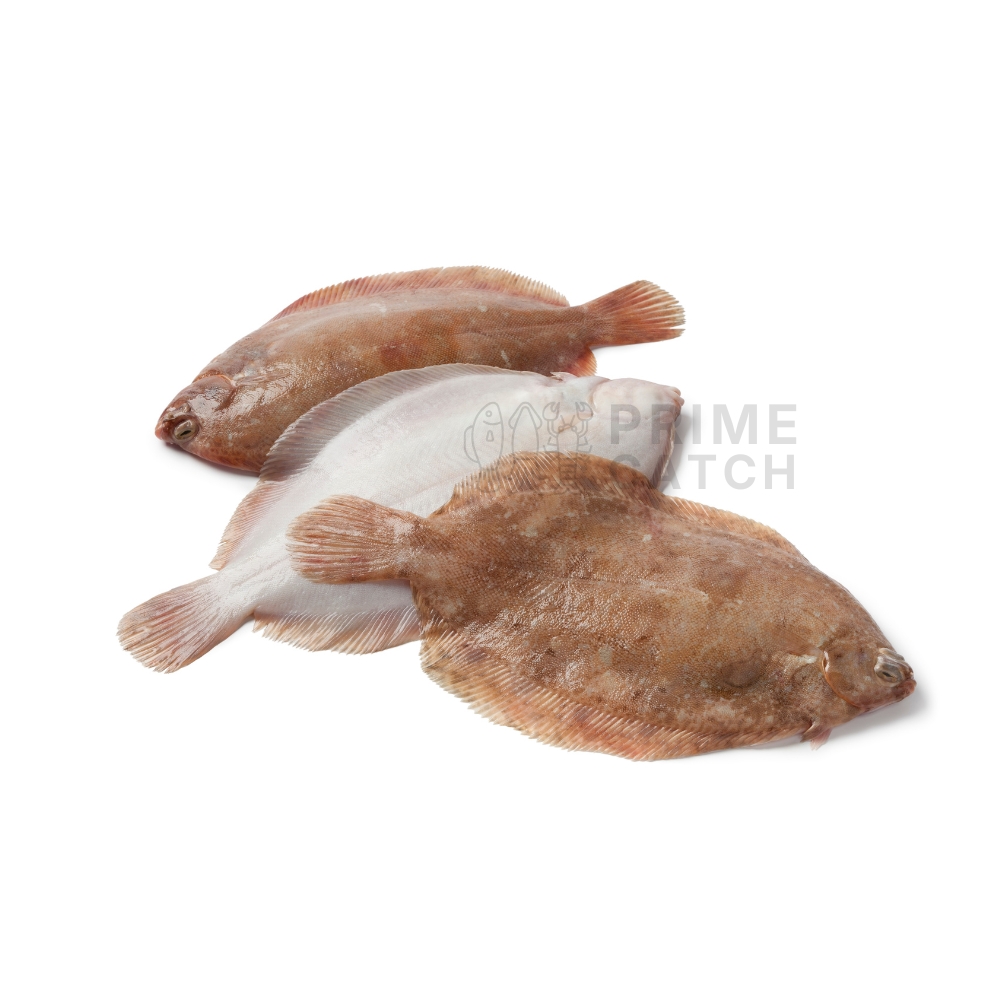
Pseudorhombus arsius is not a fish of dramatic physical presence. It is extraordinarily flat, lying almost perfectly level against the sandy and muddy seabeds of the Arabian Sea coastal shelf, so well-camouflaged against its substrate that it is practically invisible until the moment it moves. It is not large. It does not have the commanding scale of the tuna or the theatrical colouration of the snapper. What it has is a white flesh of rare delicacy and sweetness that has made it a staple of the finest home seafood tables across the Indo-Pacific for generations, and in particular one of the most genuinely beloved fish among families with children who are being introduced to the pleasures of real, fresh seafood for the first time.
At Prime Catch, we source exclusively wild-caught Largetooth Flounder from the sandy and muddy coastal shelf waters of the Sindh and Balochistan coastlines, where the species inhabits the shallow, warm, demersal zones at depths from the immediate shoreline to approximately 100 metres. Landed fresh at Karachi Fish Harbour, handled without chemical treatment, and delivered without the compromise of freezing, our Flounder arrives at your kitchen in the condition that its exceptionally delicate flesh demands: absolutely fresh, with nothing added and nothing diminished.
A note for clients already familiar with the name from European menus: the Dover Sole and Lemon Sole celebrated in the finest European kitchens are cold-water species of the North Atlantic and are not present in the Arabian Sea. The Largetooth Flounder is the Indo-Pacific’s own representative of the great flatfish family, and in the warm, productive coastal waters of the Arabian Sea it produces a fish of entirely comparable eating quality to its more celebrated European relatives.
Flavour Profile
The Largetooth Flounder is a fish of genuine, uncomplicated excellence, and that simplicity is the source of its considerable charm.
The flesh is white, fine-grained, and very lean, with a flavour of clean, soft sweetness that is among the mildest and most approachable of any species in the Prime Catch portfolio. There is no assertiveness, no brininess, no challenging mineral intensity. The flavour is a gentle, clean oceanic delicacy that speaks quietly but clearly of the quality of the sea it came from, and it finishes with a brief, refreshing clarity that leaves the palate entirely satisfied without any sense of heaviness or residual fishiness.
This mildness is not a deficit. It is the precise quality that makes the Largetooth Flounder the most universally appealing fish in a serious seafood household. Adults who enjoy the subtlety of a delicate white fish will find it fully rewarding prepared with the simplest possible technique and the highest possible quality of accompaniment. Children, who are the most honest judges of flavour and texture in any kitchen, tend to take to it immediately: there is nothing in the Flounder’s character that challenges, nothing that demands prior experience, nothing that requires negotiation. It is simply a clean, sweet, mild, and deeply pleasant fish, and that is precisely what makes it one of the most valuable items on the Prime Catch list.
The texture is very fine and delicate, softer and more yielding than the Indian Halibut despite their shared flatfish lineage. The flesh flakes easily and cleanly along its natural grain, producing a light, almost pillowy result when correctly cooked. It is a texture particularly suited to gentle cooking methods, steaming, light pan-frying, and baking, all of which preserve the moisture and delicacy of the flesh far better than the high-heat methods appropriate for firmer species.
Habitat
Pseudorhombus arsius is widely distributed across the Indo-West Pacific, with a range extending from the Persian Gulf and the east coast of Africa through the Arabian Sea, the Bay of Bengal, Southeast Asia, and northward to southern Japan and southward to the northern coast of Australia. It is one of the most broadly distributed flatfish species in the region and a confirmed and established component of the Arabian Sea demersal fish community.
In Pakistani waters, the Largetooth Flounder inhabits the sandy and muddy bottoms of the coastal shelf along the Sindh and Balochistan coastlines, at depths from the immediate nearshore zone to approximately 200 metres. It is a demersal species of considerable camouflage ability, capable of altering its upper-surface colouration to match the substrate on which it rests with remarkable precision. It forages along the seafloor on small fish and benthic invertebrates, lying in wait with remarkable stillness before striking at passing prey with a speed entirely disproportionate to its sedentary appearance.
The species is caught primarily by trawl and bottom-set gillnet operations along the Sindh and Balochistan coastline, with all catch landed directly at Karachi Fish Harbour.
Taxonomy
| Classification Level | Detail |
|---|---|
| FAO Name | Largetooth Flounder |
| Scientific Name | Pseudorhombus arsius (Hamilton, 1822) |
| Common Names | Largetooth Flounder, Large-toothed Flounder, Largetooth Sand Flounder |
| Phylum | Chordata |
| Class | Actinopterygii |
| Order | Pleuronectiformes |
| Family | Paralichthyidae |
| Genus | Pseudorhombus |
| Species | arsius |
| FAO Species Code | FLR |
| IUCN Status | Not Evaluated |
Pseudorhombus arsius was formally described by the Scottish physician and naturalist Francis Buchanan-Hamilton in 1822. The genus name Pseudorhombus derives from the Greek pseudes, meaning false, and rhombos, meaning parallelogram, a reference to the characteristic diamond-like flat body shape of the fish. The species belongs to the family Paralichthyidae, the large-tooth flounders, a group of left-eyed flatfish characterised by the position of both eyes on the left side of the body and a set of notably large, prominent teeth in the anterior jaws, a reminder that this apparently docile bottom-dweller is an active and effective ambush predator.
Physical Attributes
| Attribute | Detail |
|---|---|
| Body Form | Oval-shaped, extremely laterally compressed and flat, approximately 1.8 to 2.3 times as deep as its standard length |
| Eye Position | Left-eyed flatfish: both eyes on the upper (left) side of the body in adults |
| Maximum Length | 45 cm total length |
| Common Length | 25 to 35 cm |
| Body Colour (upper surface) | Yellowish-brown to greenish-brown, mottled with darker brown markings and two distinctive dark blotches on the lateral line |
| Body Colour (lower surface) | Plain white to pale cream, the blind side of the fish |
| Teeth | Large, prominent canine teeth in the anterior jaws, the defining feature of this species within its genus |
| Flesh Colour (raw) | Bright white to pure ivory, very fine-grained and lean |
| Flesh Colour (cooked) | Clean white, soft, and finely flaking |
| Texture (raw) | Very soft, delicate, and fine-grained, more yielding than the Indian Halibut |
| Texture (cooked) | Light, moist, and gently flaking, with a pillowy softness entirely characteristic of the species |
| Fat Content | Low, a very lean white-fleshed species |
| Available Preparations | Whole Round · Whole Gutted and Cleaned Head-On · Headless Gutted and Cleaned |
A Note on Preparation and the Flat Body
The Largetooth Flounder’s body architecture is the most extreme of any species in the Prime Catch portfolio, and it places genuine constraints on the preparation formats we can responsibly offer.
The fish is so flat and so thin in cross-section that cross-cut steaks, which work beautifully on a cylindrical species like the Cobia or a deep-bodied species like the Snapper, produce nothing useful on a Flounder: the individual pieces would be paper-thin, structurally fragile, and entirely impractical to cook or serve. For the same reason, the boneless fillet format, while technically achievable, produces fillets of such delicacy and thinness on a fish of this size that they are extremely difficult to handle without breaking, and the yield loss is considerable.
The Largetooth Flounder is a fish that is best prepared and presented whole, with the flesh eaten directly from the bone at the table in the traditional manner of the finest flatfish preparations across Europe, East Asia, and the Middle East alike. This is not a compromise. It is the authentic preparation of this class of fish, and the way that the finest restaurants in the world have always served flounder, sole, and their relatives: whole, simple, and exactly as the sea intended.
Prime Catch therefore offers this species in three whole-fish formats only, each one an honest expression of the product as it is.
Whole Round — The fish as landed: whole, ungutted, and entirely intact. The ultimate freshness format, with the characteristic flat body, bright eyes, vivid upper-surface colouration, and firm belly all immediately assessable. For experienced cooks who prefer to begin preparation at the most pristine possible starting point.
Whole Gutted and Cleaned, Head-On — Eviscerated, cleaned, and rinsed, with head and tail fully intact. The standard preparation for pan-frying, steaming, baking, and grilling the whole Flounder. The head is retained in this format as it contributes to the aromatic character of the fish during cooking and maintains the structural integrity of the whole-fish presentation.
Headless Gutted and Cleaned — Gutted, cleaned, and head-removed. A practical, neat format for those who prefer a more manageable fish at the table, particularly when serving younger family members for whom the presence of the head at the plate can be a distraction. All of the prime flesh is retained in this format.
Cooking Preferences — International Fine Dining
The Largetooth Flounder’s mild, clean flavour and delicate texture make it one of the most broadly appealing fish for the family seafood table and the fine dining plate alike. Its flat body architecture, far from limiting its culinary applications, defines a set of preparation traditions that are among the most refined and most globally recognised in the entire world of flatfish cookery.
Europe — The Flatfish Tradition at Its Most Refined: European fine dining has the deepest and most technically developed tradition of flatfish cookery in the world, and the Largetooth Flounder is a natural fit within it. A whole gutted flounder, dusted lightly in seasoned flour and pan-fried in clarified butter until the skin is golden on both sides, dressed at the table with a squeeze of lemon and a scattering of fresh parsley, is a dish of irreducible correctness that has been served in the finest coastal restaurants of France, Belgium, and the British Isles for centuries under the name meunière. The same fish, steamed whole over a court-bouillon of white wine, shallots, and herbs, then dressed with a simple beurre blanc, is the more refined, less assertive expression of the same philosophy. Both preparations showcase the delicate white flesh at its most honest and most elegant.
The Americas — Baked, Stuffed and Gently Seared: Across North and South American fine dining, the flatfish’s mild, clean character and gentle texture make it a natural partner for citrus, fresh herbs, and light cream-based sauces that complement without overwhelming. Whole baking in a light white wine and herb broth, with the fish lying flat on the pan and the aromatic liquid basting it from below throughout cooking, produces a dish of considerable delicacy. The Latin American tradition of whole flatfish dressed in fresh citrus, chilli, and coriander oil is a preparation of natural brightness that the Flounder’s clean flavour carries with complete ease.
East Asia — Steamed Whole and Ginger-Dressed: East Asian culinary philosophy finds its most natural expression with the Largetooth Flounder in whole steaming, a preparation in which the flat body is perfectly suited to even, rapid heat distribution and maximum aromatic penetration. Steamed whole over ginger-infused water, finished with cascading hot oil, spring onion, and aged soy sauce, the flounder produces a dish of extraordinary purity and delicacy. Japanese preparations of whole flatfish, lightly salt-grilled or simmered in a light dashi-based broth with mirin and soy, produce a fish of considerable elegance and complete nutritional integrity.
South and Southeast Asia — Lightly Spiced, Fried and Family-Style: Across the coastal traditions of South and Southeast Asia, the flatfish is a beloved family fish, the one most reliably accepted by all members of the household regardless of age or prior experience with seafood. Shallow-frying the whole gutted fish in a light turmeric-and-salt marinade produces a golden, lightly spiced crust that gives way to soft, white, sweet flesh that children eat enthusiastically. Light coconut milk preparations with fresh curry leaf and mild green chilli showcase the fish’s capacity to carry gentle, fragrant aromatics without losing its own delicate character.
The Middle East and Mediterranean — Baked, Charcoal-Grilled and Herb-Dressed: Across the Arabian Gulf and the broader Middle Eastern table, the flatfish holds a familiar and well-loved place at the family seafood spread. Whole baking with olive oil, za’atar, lemon, and fresh herbs produces a fish of clean, aromatic simplicity that is as appropriate for a relaxed family dinner as it is for a composed and refined table. Gentle charcoal-grilling over moderate heat, with the flat body laid directly on the grill, cooks the fish evenly and quickly, producing a lightly smoky, herb-scented result that the mild flesh carries with natural elegance.
General Guidance for Home Preparation: The most important rule with the Largetooth Flounder is gentleness at every stage, from cleaning to cooking to serving. The flesh is delicate and will not forgive rough handling or excessive heat. For pan-frying, use moderate rather than high heat and allow the fish to cook undisturbed until it releases naturally from the pan surface. A whole gutted medium flounder requires no more than 3 to 4 minutes per side in a moderate pan, or 10 to 12 minutes in a 180 degree oven. The flesh is ready when it pulls cleanly from the bone with the gentle pressure of a fork. It is a fish that rewards patience and a light hand above all else.
Health Benefits
The Largetooth Flounder presents a nutritional profile of clean, efficient simplicity, combining the lean protein density of a very low-fat white fish with the essential marine micronutrients that make wild-caught Arabian Sea species consistently superior dietary choices.
High-Quality Complete Protein — Lean, Clean and Accessible The Largetooth Flounder delivers approximately 17 to 21 grams of complete protein per 100 grams of edible flesh, containing all nine essential amino acids in optimal biological ratios, at a caloric density that is among the lowest of any animal protein source. Its very low fat content makes it an exceptionally clean, light protein source ideally suited to those managing caloric intake, cardiovascular health, or weight without compromising protein quality. Reference: WebMD — Health Benefits of Fish
Omega-3 Fatty Acids — Cardiovascular and Cognitive Support As a wild-caught marine species feeding on natural benthic invertebrates and small fish in the productive coastal waters of the Arabian Sea, the Largetooth Flounder provides meaningful concentrations of EPA and DHA omega-3 fatty acids, supporting cardiovascular health, reducing systemic inflammation, and contributing to neurological function maintenance. Reference: Harvard Health Publishing — Omega-3 Fatty Acids: An Essential Contribution
Exceptionally Low in Fat and Calories — Ideal for All Ages The Largetooth Flounder is one of the leanest animal proteins available anywhere in any culinary tradition, essentially negligible in saturated fat and very modest in total caloric value. It is among the most strongly recommended fish species for children, for individuals managing cardiovascular conditions or metabolic health, and for anyone seeking a protein source of the highest quality at the lowest caloric cost. Reference: Mayo Clinic — Dietary Fats
Selenium — Antioxidant Defence and Thyroid Support The Largetooth Flounder is a meaningful dietary source of selenium, the trace mineral essential for oxidative free radical neutralisation, immune system regulation, and thyroid hormone synthesis, at concentrations that make a standard serving a clinically relevant dietary contribution. Reference: Mayo Clinic — Selenium
Iodine — Thyroid and Metabolic Regulation As a wild marine species inhabiting the iodine-rich coastal shelf waters of the Arabian Sea, Pseudorhombus arsius accumulates dietary iodine at levels of genuine clinical significance, supporting healthy thyroid function, metabolic regulation, and neurological development, particularly important for growing children and pregnant women. Reference: Harvard Health Publishing — Iodine Deficiency
Vitamin B12 — Neurological and Haematological Health Marine fish are among the richest whole-food sources of Vitamin B12, essential for neurological function, red blood cell formation, and DNA synthesis. The Largetooth Flounder provides this critical nutrient at concentrations that make a standard serving a meaningful daily contribution for all age groups. Reference: Mayo Clinic — Vitamin B12
Phosphorus — Bone Development and Cellular Energy The Largetooth Flounder is a concentrated source of phosphorus, the mineral second only to calcium in bone and dental mineralisation and essential for cellular energy metabolism. Its high phosphorus content relative to its modest caloric footprint makes it a particularly efficient dietary source of this mineral for growing children. Reference: Harvard Health Publishing — Phosphorus in Your Diet
A Note on Prime Catch Standards
Every Largetooth Flounder bearing the Prime Catch name is:
- Wild-caught from the sandy and muddy coastal shelf waters of the Arabian Sea
- Fresh, never frozen — landed at Karachi Fish Harbour and delivered within hours
- Chemical-free — zero preservative treatment of any kind
- Handled with maximum care — the most delicate flesh structure of any non-oily species in the Prime Catch portfolio
- Available in three whole-fish formats — Whole Round, Whole Gutted and Cleaned Head-On, and Headless Gutted and Cleaned, reflecting the honest preparation limitations of this species’ flat body architecture
- Priced per kilogram across all preparation formats
Prime Catch. For those who accept no substitution.
Reviews
There are no reviews yet.