
Introduction
There is a fish that has defined the luxury seafood table for generations — in the private dining rooms of European capitals, the omakase counters of Tokyo, the five-star hotel kitchens of the Gulf, and the most ambitious home kitchens on every continent. That fish is the Atlantic Salmon of Norway.
Salmo salar — the Leaper — is not merely a species. It is a standard. Norwegian Atlantic Salmon has earned its position at the apex of the global seafood market through a combination of geography, cold-water purity, and a centuries-old culture of quality that has no parallel in the industry. The fjord-cut coastline of Norway, fed by some of the coldest, most oxygen-rich waters on earth, produces a salmon of extraordinary fat marbling, structural integrity, and flavour depth that has made it the benchmark against which every other salmon in the world is measured.
At Prime Catch, we source Norwegian Atlantic Salmon as whole, skin-on fillets — vacuum-packed at source to preserve the full integrity of the fish from the moment it leaves Norwegian waters to the moment it arrives at your table. Each fillet weighs between 1.4 and 1.7 kilograms: a specimen of genuine scale and presence, suited to a centrepiece roast, a composed dinner party service, or a serious kitchen’s weekly staple.
This is not supermarket salmon. This is the real thing — sourced, handled, and presented to the standard that Prime Catch’s clientele expects and deserves.
Flavour Profile
Norwegian Atlantic Salmon is the most flavourfully complex cold-water fish in regular commercial availability — and its complexity is, above all else, a function of fat.
The dominant characteristic is a deep, rich, oceanic unctuousness — a full-bodied, almost buttery quality derived from the species’ exceptional intramuscular fat content. Norwegian cold-water salmon, developing slowly in frigid, high-oxygen environments, accumulates significantly more intramuscular fat than salmon from warmer waters — and it is this fat that carries the flavour, the colour, and the celebrated silkiness of texture that defines the species.
The primary flavour note is clean and subtly marine — never fishy, never sharp. Beneath it lies a rich, savoury depth with a long, lingering finish that distinguishes the finest fillets from ordinary product. The flesh carries a faint, sweet nuttiness in the mid-palate — a characteristic particularly pronounced in properly rested, gently cooked specimens — that makes Norwegian salmon one of the few fish in the world that can hold its own against a full-bodied white Burgundy or a lightly oaked Chardonnay.
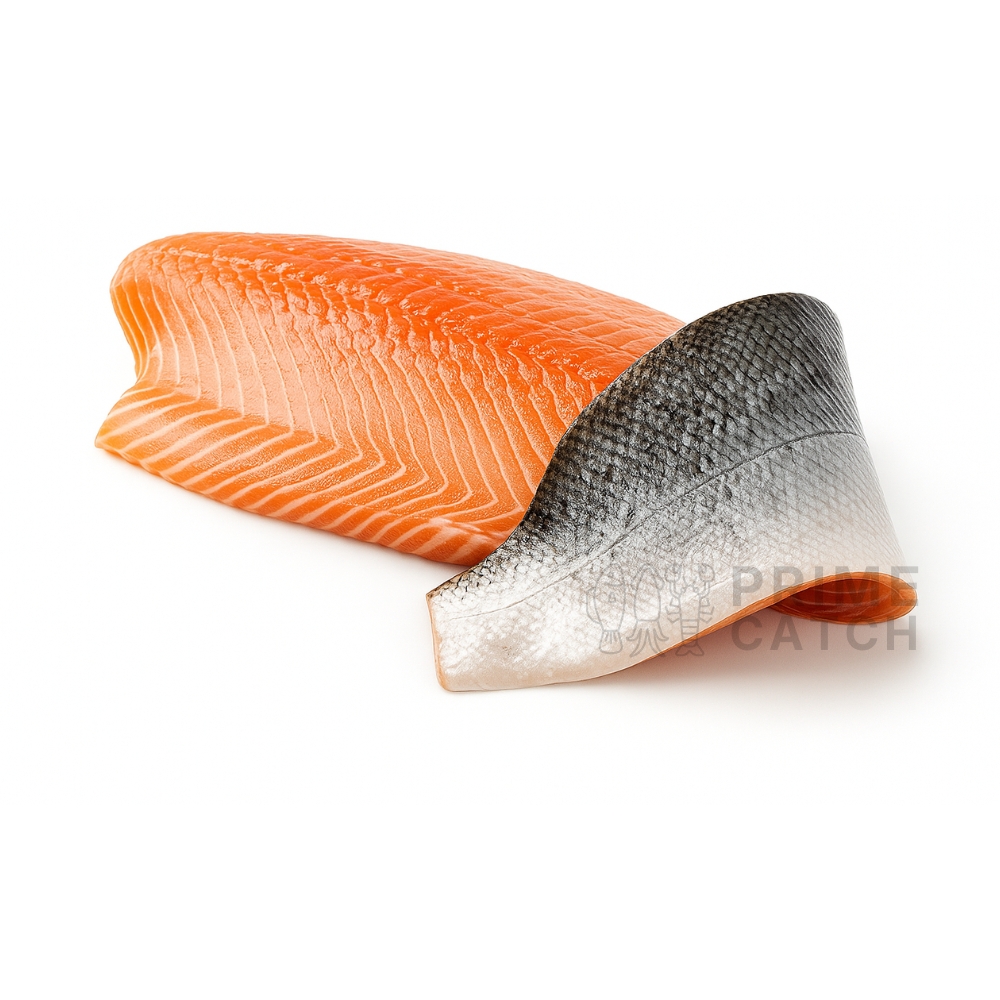
The raw flesh — vivid coral-orange, marbled with the fine white lines of intramuscular fat — is among the most visually spectacular of any fish available. Cooked, it transitions to a pale, opaque coral with a moist, gently flaking interior that is the hallmark of correctly handled Norwegian product.
Habitat
Salmo salar — the Atlantic Salmon — is a cold-water species native to the North Atlantic Ocean and its tributary river systems, with a natural range extending from the rivers of Norway, Iceland, and the British Isles across to the eastern seaboard of North America. Norway occupies a position of singular advantage within this range: its deeply indented fjord coastline, fed by the cold, nutrient-rich waters of the Norwegian Sea and the North Atlantic Current, provides environmental conditions of exceptional quality.
Norwegian waters are characterised by temperatures that rarely exceed 14°C even in summer, exceptional dissolved oxygen content, strong tidal currents that maintain water quality and promote vigorous muscle development, and a cold-water marine food chain of remarkable richness. It is these environmental conditions — cold, clean, oxygenated, and nutrient-dense — that produce the fat marbling, the firm texture, and the flavour complexity for which Norwegian Atlantic Salmon has been celebrated for decades.
Norway is the world’s largest producer of Atlantic Salmon and maintains some of the most rigorously enforced aquaculture and fisheries standards in the global industry — governed by the Norwegian Food Safety Authority and subject to regular independent inspection. The Norwegian Salmon industry’s global reputation for quality is not marketing; it is the product of decades of regulatory discipline and environmental stewardship.
Taxonomy
| Classification Level | Detail |
|---|---|
| FAO Name | Atlantic Salmon |
| Scientific Name | Salmo salar (Linnaeus, 1758) |
| Common Names | Atlantic Salmon, Norwegian Salmon, The Leaper |
| Phylum | Chordata |
| Class | Actinopterygii |
| Order | Salmoniformes |
| Family | Salmonidae |
| Genus | Salmo |
| Species | salar |
| FAO Species Code | SAL |
| Origin | Norway |
| IUCN Status | Least Concern |
Salmo salar was formally described by the Swedish naturalist Carl Linnaeus in 1758 and stands as the founding member of the Salmonidae family — the most prestigious lineage in cold-water fish, encompassing salmon, trout, char, and the grayling. The species name salar derives from the Latin for “leaper” — a reference to the Atlantic Salmon’s celebrated ability to ascend waterfalls during its spawning migration, one of the most dramatic behaviours in the natural world.
Physical Attributes
| Attribute | Detail |
|---|---|
| Product Form | Whole skin-on fillet, bone-out |
| Skin-On Fillet Weight | 1.4 kg – 1.7 kg per fillet |
| Origin | Norway |
| Packaging | Individual vacuum-pack — sealed at source |
| Storage | Frozen |
| Flesh Colour (raw) | Deep coral-orange with pronounced white intramuscular fat marbling |
| Flesh Colour (cooked) | Pale coral to soft orange — moist and gently flaking |
| Skin | Intact, silver-scaled Norwegian skin — renders to a golden, crackling finish when pan-seared |
| Texture (raw) | Dense, yielding, and richly marbled — firm to the touch |
| Texture (cooked) | Silky, moist, and deeply flaking — characteristically buttery |
| Fat Content | High intramuscular fat — the defining quality attribute of Norwegian cold-water salmon |
| Portions per Fillet | Approximately 6 – 8 generous portions depending on preparation |
The whole skin-on fillet is the professional kitchen’s preferred format — preserving the full structural integrity of the fish, allowing precise portioning by the cook, and providing the skin as a cooking surface of considerable culinary value in its own right.
Cooking Preferences — International Fine Dining
Norwegian Atlantic Salmon’s exceptional fat content, structural integrity, and universal flavour profile make it one of the most versatile luxury fish in the world — equally at home in a raw preparation as in a high-heat sear or a slow oven roast.
Europe — The Natural Home of Salmon: In European fine dining, Norwegian Salmon is the default luxury fish — present on virtually every serious tasting menu from Oslo to Lisbon. The classic European preparation is a skin-side sear in clarified butter or neutral oil at high heat, finishing in a low oven — producing the celebrated crisp, golden skin and barely-set, translucent coral interior that defines the dish. Cured preparations — salt, sugar, dill, and time — produce the gravlax of Scandinavian tradition, one of the great cold starters of the European table. Poached in a court-bouillon and served at room temperature with a sauce verte or a classical hollandaise, the salmon requires nothing further to be extraordinary.
The Americas — Celebrated Across Every Format: Norwegian Salmon is the most consumed luxury fish across North and South America — present in fine dining, casual luxury, and the most ambitious home kitchens alike. Cedar plank grilling over live wood fire, butter-basting with aromatic herbs, and citrus-glazed oven roasting are among the dominant techniques. In Latin American fine dining, salmon ceviche and tiradito — thin-sliced raw salmon dressed in citrus, chilli, and aromatics — showcase the fish’s exceptional raw quality. The U15 salmon tartare, finely hand-cut and dressed simply, is a celebrated first course across the finest restaurants of the region.
East Asia — Raw, Cured & Precisely Cooked: Norway’s relationship with East Asian seafood culture is one of the most celebrated commercial and culinary partnerships of the modern era. Norwegian Atlantic Salmon is the single most popular sashimi and sushi fish across East Asia — its fat marbling, clean flavour, and food-safety credentials making it the benchmark raw fish on any omakase counter or sushi restaurant menu. Briefly torched over the counter — aburi style — the intramuscular fat caramelises to produce an extraordinary savoury sweetness. Miso-marinated and oven-roasted, or saikyo-yaki style with white miso and mirin, the salmon becomes one of the defining dishes of the modern Japanese kitchen.
South & Southeast Asia — Spiced, Grilled & Coconut-Enriched: The salmon’s robust fat content makes it uniquely well-suited to the bold, aromatic spicing traditions of South and Southeast Asian cooking — holding its own against turmeric, lemongrass, galangal, and chilli without losing its essential character. Tandoor-roasted, marinated in yoghurt and warming spices, it produces a smoky, caramelised exterior with a moist, richly flavoured interior. Green curry preparations across the region treat the salmon’s fat as a medium for carrying coconut and herb aromatics through the flesh — a preparation of genuine sophistication when the base ingredient is of Norwegian quality.
The Middle East & Mediterranean — Wood-Fired, Spiced & Mezze-Style: Across the Middle East and Mediterranean, Norwegian Salmon occupies a position of prestige at the luxury table — served whole-roasted over wood fire with za’atar, sumac, and pomegranate molasses at the finest Lebanese-style restaurants, or presented as cold-smoked slices alongside labneh, capers, and warm bread as an elevated mezze opener. The fish’s fat content responds beautifully to the wood-smoke and charcoal of the region’s live-fire traditions — developing a rich, deeply savoury crust while maintaining an extraordinarily moist interior.
General Guidance for Home Preparation: Bring the fillet to room temperature for 20–30 minutes before cooking. For a skin-on sear, ensure the skin is thoroughly dry before it meets the pan — moisture is the enemy of a proper skin crisp. Cook skin-side down for 70–80% of the total cooking time. The interior should remain slightly translucent at the centre — Norwegian salmon is a fish that improves dramatically with the confidence to undercook it marginally.
Health Benefits
Norwegian Atlantic Salmon is widely regarded by nutritional scientists and clinical dietitians as one of the most comprehensively beneficial foods available — combining an unmatched omega-3 fatty acid profile, high-quality complete protein, and a dense array of fat-soluble vitamins in a single, extraordinarily palatable ingredient.
Omega-3 Fatty Acids — The Gold Standard Source Norwegian Atlantic Salmon is one of the single richest dietary sources of EPA and DHA — the long-chain omega-3 fatty acids with the most robust clinical evidence base for cardiovascular protection, cognitive function, inflammation reduction, and mental health support. A single 200g portion can deliver over 4g of combined EPA and DHA — well in excess of the weekly intake recommended by most national health authorities. The exceptional fat marbling of Norwegian cold-water salmon makes it the most omega-3-dense salmon available. Reference: Harvard Health Publishing — Omega-3 Fatty Acids: An Essential Contribution
High-Quality Complete Protein A standard 200g serving of Atlantic Salmon delivers approximately 40g of complete protein — containing all nine essential amino acids in optimal biological ratios. It is one of the most protein-dense whole foods available and is consistently recommended by clinical nutritionists as a cornerstone of high-quality dietary protein intake. Reference: WebMD — Health Benefits of Salmon
Vitamin D — The Sunshine Nutrient Atlantic Salmon is one of the very few significant dietary sources of Vitamin D — the fat-soluble vitamin essential for calcium absorption, bone density, immune function, and mood regulation. Deficiency is widespread globally, particularly in populations with limited sun exposure. A single serving of Norwegian Salmon can provide 75–100% of the recommended daily intake. Reference: Harvard Health Publishing — Vitamin D and Your Health
Vitamin B12 — Neurological & Cardiovascular Health Norwegian Salmon is an exceptional source of Vitamin B12 — essential for neurological function, red blood cell formation, and DNA synthesis. A standard serving provides well over 100% of the recommended daily intake, making it one of the most efficient dietary sources of this critical nutrient. Reference: Mayo Clinic — Vitamin B12
Selenium — Antioxidant & Thyroid Support Atlantic Salmon provides clinically meaningful quantities of selenium — the trace mineral central to antioxidant defence, thyroid hormone metabolism, and immune regulation. Norwegian salmon raised in cold, selenium-rich North Atlantic waters accumulates this mineral at concentrations of genuine dietary significance. Reference: Mayo Clinic — Selenium
Astaxanthin — The Carotenoid Behind the Colour The characteristic deep coral-orange of Norwegian salmon flesh is attributable to astaxanthin — a marine carotenoid antioxidant with a growing body of clinical evidence supporting anti-inflammatory, neuroprotective, skin-health, and cardiovascular benefits. The vivid, consistent colour of Norwegian salmon is a direct indicator of astaxanthin concentration and a recognised quality marker in the industry. Reference: Healthline — 7 Impressive Benefits of Astaxanthin
Cardiovascular Health — Broad Clinical Consensus The combination of omega-3 fatty acids, lean complete protein, and fat-soluble micronutrients in Atlantic Salmon places it among the most strongly recommended foods for cardiovascular health by major international health authorities. Regular consumption is associated with reduced triglyceride levels, improved HDL cholesterol profiles, lower inflammatory markers, and reduced risk of cardiac events. Reference: Mayo Clinic — Omega-3 in Fish: How Eating Fish Helps Your Heart
A Note on Prime Catch Standards
Every Norwegian Atlantic Salmon fillet bearing the Prime Catch name is:
- Norwegian origin — sourced from the world’s most respected and rigorously regulated salmon-producing nation
- Whole skin-on fillet — the professional kitchen format, preserving full structural integrity and portioning flexibility
- Vacuum-packed at source — sealed immediately to lock in freshness, colour, and flavour from Norwegian waters to your kitchen
- No additives or preservatives — as labelled; clean ingredient, clean handling
- 1.4 kg – 1.7 kg per fillet — approximately 6 to 8 generous portions per piece
- Priced per fillet — reflecting current market rates for Norwegian import-grade product
Prime Catch. For those who accept no substitution.
Reviews
There are no reviews yet.