
Introduction
There is a reason the Indian Prawn has sustained the greatest seafood markets in the world for centuries.
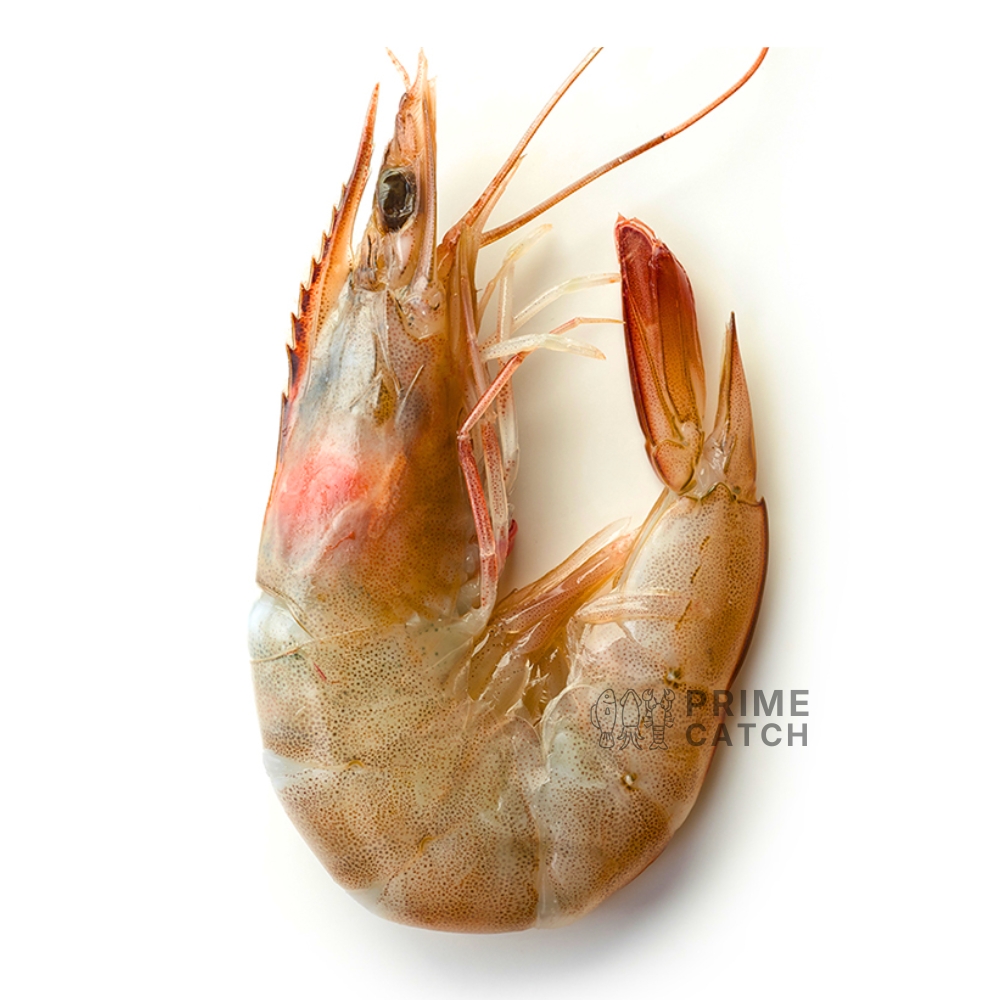
Penaeus indicus — lithe, translucent, and possessing a flavour that requires no embellishment — represents the Indo-Pacific’s most elegant crustacean offering. At Prime Catch, we source exclusively from the tidal estuaries and shallow continental shelf waters of the Sindh and Balochistan coastlines, where the Indus Delta’s nutrient-rich outflow meets the open Arabian Sea in a collision of biological richness unmatched anywhere in the region.
We source the U15 grade exclusively: fewer than fifteen specimens per kilogram — each prawn a specimen of generous size, clean form, and unmistakable freshness. These are not the limp, chemically whitened prawns of the supermarket chiller. These are wild creatures, drawn from the living tidal waters off Pakistan’s coastline — untouched by preservatives, never subjected to the flavour-stripping brutality of commercial freezing.
What arrives at your table is precisely what the sea surrendered that morning at Karachi Fish Harbour — nothing added, nothing diminished.
Prime Catch’s Indian White Prawn is for those who understand that true refinement in food is not about spectacle. It is about provenance. It is about purity. It is the irreducible difference between something that was caught and something that was merely processed.
Flavour Profile
The Indian Prawn is, above all else, a study in delicacy. Where the Black Tiger commands with power, Penaeus indicus seduces with subtlety — and in the hands of a discerning cook or a serious kitchen, that subtlety is the more demanding and ultimately the more rewarding quality.
The dominant note is a clean, sweet oceanic freshness — lighter and more translucent in character than the Black Tiger, yet no less complex in its own right. There is no brininess for its own sake; instead, a gentle mineral clarity that speaks directly to the pristine open waters of the Arabian Sea. The mid-palate carries a faint, almost milky sweetness unique to this species — a quality prized in the finest Japanese, French, and Scandinavian preparations. The finish is brief, clean, and refreshing.
The texture, at U15 grade, is where the specimen distinguishes itself most clearly from lesser or improperly handled product: a tender, yielding bite with a delicate snap — never rubbery, never soft. The flesh is fine-grained and moist, holding its integrity across a wide range of cooking techniques, though demanding considerably more precision from the cook than a larger specimen would.
In its finest preparation — raw, lightly dressed, or barely warmed — the Indian Prawn offers one of the most honest expressions of the Arabian Sea available on any plate.
Habitat
Penaeus indicus inhabits the shallow, warm coastal and estuarine waters of the Indo-West Pacific — ranging from the eastern coast of Africa across the Indian subcontinent and into Southeast Asia. In Pakistan, the species is most densely concentrated in the biologically rich tidal zones of the Indus Delta, the estuarine creek systems of the Sindh coast, and the nearshore continental shelf waters extending along the Makran coastline of Balochistan.
The Arabian Sea’s exceptional productivity — driven by the southwest monsoon-induced upwelling that delivers cold, nutrient-dense water to the surface — creates ideal feeding and growth conditions for Penaeus indicus. The species forages on organic detritus, microalgae, and small invertebrates in the silty, mangrove-fringed shallows, accumulating the characteristic sweetness and delicacy of flavour that distinguishes wild Arabian Sea specimens from their aquaculture counterparts.
Prime Catch sources exclusively from artisanal fishing communities and responsible semi-industrial operations along the Sindh and Balochistan coastline — vessels that land their catch directly at Karachi Fish Harbour, where our team takes custody within hours of landing.
Taxonomy
| Classification Level | Detail |
|---|---|
| FAO Name | Indian White Prawn |
| Scientific Name | Penaeus indicus (H. Milne-Edwards, 1837) |
| Common Names | Indian White Prawn, White Prawn |
| Phylum | Arthropoda |
| Class | Malacostraca |
| Order | Decapoda |
| Family | Penaeidae |
| Genus | Penaeus |
| Species | indicus |
| FAO Species Code | PEI |
| IUCN Status | Not Evaluated (wild stocks) |
Penaeus indicus was first formally described by the French zoologist Henri Milne-Edwards in 1837 and remains among the most commercially significant members of the Penaeidae family — the same aristocratic lineage that includes the Giant Tiger Prawn. It is the dominant prawn species of the Arabian Sea and the backbone of Pakistan’s artisanal prawn fishery.
Physical Attributes
| Attribute | Detail |
|---|---|
| Size Grade | U15 (Under 15 pieces per kilogram) |
| Average Weight per Piece | 65g – 90g |
| Average Length | 16 cm – 22 cm (head-on) |
| Shell Colour | Pale translucent white to soft ivory, with subtle blue-grey lateral banding |
| Flesh Colour (raw) | Translucent pearl-white with a delicate blush at the tail fan |
| Flesh Colour (cooked) | Clean, bright white with a pale coral edge — characteristic of the species |
| Texture (raw) | Tender, fine-grained, with firm segmentation and a clean break |
| Texture (cooked) | Delicately yielding, moist, and lightly snapping — never rubbery |
| Antennae | Long and fully intact on Prime Catch-grade specimens |
| Roe Presence | Occasional on mature female specimens — a mark of wild origin |
| Presentation Options | Whole Head-On Shell-On (HOSO) · Shell-On Head-Off (SOHO) · Easy-Peel Tail-On (EPTO) · Peeled & Deveined Tail-On (PDTO) · Peeled & Deveined Tail-Off (PD) |
At U15, each Indian White Prawn from Prime Catch is a specimen of confident individual presence — generous enough to anchor a plated starter or hold its own in a composed dish, yet refined enough in flavour to demand the restraint of the finest kitchens.
Cooking Preferences — International Fine Dining
The Indian Prawn’s delicate flavour, fine texture, and exceptional versatility across preparation styles make it one of the most widely used luxury crustaceans in professional kitchens across the world. Its subtlety rewards restraint — and punishes carelessness.
Europe — Butter, White Wine & the Art of Restraint: European fine dining traditions were built in part on the delicate sweet prawn — and the Indian White Prawn from the Arabian Sea occupies precisely that position in a contemporary European kitchen. Poached gently in court-bouillon and dressed with beurre nantais, sautéed briefly in clarified butter with fine herbs, or served chilled in a composed first course — these are preparations designed around an ingredient of pristine quality. At the most refined end of the European table, the very freshest specimens are presented simply raw — a preparation entirely dependent on Prime Catch’s fresh-only, chemical-free standard.
The Americas — Ceviche, Butter Poaching & Composed Plates: Across North and South America, the delicate white prawn is the preferred species for acid-based preparations. Latin American ceviche traditions — in which the prawn is cured briefly in fresh citrus, dressed with aromatics, and served immediately — depend entirely on the clean, sweet baseline flavour of a truly fresh specimen. Any chemical treatment or prior freezing destroys the very quality these preparations are designed to celebrate. In North American fine dining, butter-poaching at low temperature is the dominant technique — producing an extraordinarily tender, enriched result that amplifies the prawn’s natural sweetness without overwhelming it.
East Asia — Steamed, Wok-Tossed & Raw: East Asian culinary philosophy reaches its most natural expression with the Indian White Prawn. The species’ clean, sweet, minimally briny character is precisely what these traditions prize above all else in a crustacean. Live steaming over ginger-infused water with aged soy and sesame is considered the purest possible preparation. High-heat wok cooking with garlic, ginger, and rice wine is the celebratory alternative. In the most elevated preparations, the freshest specimens are served raw — the species’ translucent pearl flesh and delicate sweetness considered a mark of genuine quality and sourcing integrity.
South & Southeast Asia — Aromatic, Herb-Forward & Coastal: In the coastal culinary traditions of South and Southeast Asia, the Indian White Prawn is a daily luxury — the species most closely associated with the domestic and festive seafood table across the region. Light coconut milk curries, fresh tamarind broths, turmeric-and-herb marinades, and quick wok preparations with lemongrass and kaffir lime all allow the prawn’s delicate character to express itself within a boldly aromatic context. The key, as professional chefs across the region understand, is brevity: this prawn demands short cooking and generous aromatics, never the reverse.
The Middle East & Mediterranean — Grilled, Spiced & Mezze-Style: Across the broader Middle East and Mediterranean arc, the white prawn is a prized centrepiece of the mezze table and the luxury seafood spread alike. Charcoal grilling whole, dressed in herb-infused olive oil and preserved lemon, is the dominant tradition — a method that rewards the clean shell caramelisation and sweet flesh of a wild, fresh specimen. Spiced preparations using cumin, coriander, and dried chilli feature prominently in more inland-influenced coastal cuisines, while chilled poached prawns dressed with tahini or a light citrus dressing represent perhaps the most elegant expression of the species across this storied culinary region.
General Guidance for Home Preparation: Do not overcook. The Indian White Prawn at U15 requires no more than 1.5–2 minutes per side over high heat, or 3–4 minutes in a gentle poaching liquor. Its delicate texture is its greatest virtue and its most fragile quality — the margin between perfectly cooked and overdone is measured in seconds, not minutes.
Health Benefits
The Indian Prawn is among the most nutritionally efficient seafood proteins available — combining an exceptional amino acid profile, remarkable micronutrient density, and a low-calorie, low-fat composition that positions it as one of the most health-intelligent luxury foods on any table.
High-Quality Complete Protein The Indian Prawn delivers approximately 18–24g of complete protein per 100g of edible flesh — containing all nine essential amino acids in biologically optimised ratios. For individuals managing caloric intake without compromising protein quality, it represents one of the most efficient whole-food sources available in any cuisine. Reference: WebMD — Health Benefits of Shrimp
Omega-3 Fatty Acids — Cardiovascular & Cognitive Protection Wild-caught marine prawns contain meaningful concentrations of EPA and DHA — the long-chain omega-3 fatty acids associated with reduced cardiovascular inflammation, improved lipid profiles, and documented neuroprotective benefits. Wild specimens feeding on a natural marine diet consistently exhibit superior omega-3 profiles compared to aquaculture-raised counterparts. Reference: Harvard Health Publishing — Omega-3 Fatty Acids: An Essential Contribution
Selenium — Antioxidant Defence & Thyroid Support The Indian Prawn is a concentrated source of selenium — a trace mineral essential for the neutralisation of oxidative free radicals, immune system regulation, and thyroid hormone synthesis. A standard serving can provide a substantial proportion of the recommended daily intake, making it one of the most clinically significant dietary sources available. Reference: Mayo Clinic — Selenium
Iodine — Thyroid Function & Metabolic Regulation As a marine species inhabiting iodine-rich open-sea environments, Penaeus indicus accumulates dietary iodine at clinically meaningful levels. Iodine is essential for healthy thyroid function, metabolic regulation, and neurological development — and broadly deficient in the diets of populations reliant on non-marine food sources. Reference: Harvard Health Publishing — Iodine Deficiency
Choline — Neurological & Liver Health Crustaceans are among the richest dietary sources of choline — an essential nutrient critical for cell membrane integrity, neurotransmitter synthesis, and hepatic lipid metabolism. Choline is frequently under-consumed in modern diets and is of particular importance during pregnancy for foetal neurological development. Reference: WebMD — What is Choline?
Exceptionally Low in Fat & Calories — Precision Nutrition The Indian Prawn is among the leanest animal proteins available — extremely low in total fat, negligible in saturated fat, and modest in caloric density. For those managing cardiovascular health, weight, or metabolic conditions, it represents a genuinely luxury-class protein source with the nutritional profile of a clinical dietary recommendation. Reference: Mayo Clinic — Dietary Fats
Astaxanthin — Marine Antioxidant & Anti-Inflammatory The pale coral pigmentation of cooked Indian Prawn flesh reflects the presence of astaxanthin — a marine carotenoid antioxidant with documented anti-inflammatory, photoprotective, and mitochondrial health properties. Wild-caught specimens feeding on natural marine organisms accumulate astaxanthin at concentrations that aquaculture-raised, synthetically pigmented prawns cannot replicate. Reference: Healthline — 7 Impressive Benefits of Astaxanthin
A Note on Prime Catch Standards
Every Indian Prawn bearing the Prime Catch name is:
- Wild-caught from the Arabian Sea — never pond-raised or aquaculture-produced
- Fresh, never frozen — processed and delivered within hours of landing at Karachi Fish Harbour
- Chemical-free — zero sodium metabisulphite, sodium tripolyphosphate, or any preservative treatment
- U15 grade guaranteed — no filler sizing, no grade mixing
- Available in five preparation grades — from whole head-on to fully peeled and deveined, to suit every kitchen and occasion
Prime Catch. For those who accept no substitution.
Reviews
There are no reviews yet.