
Introduction
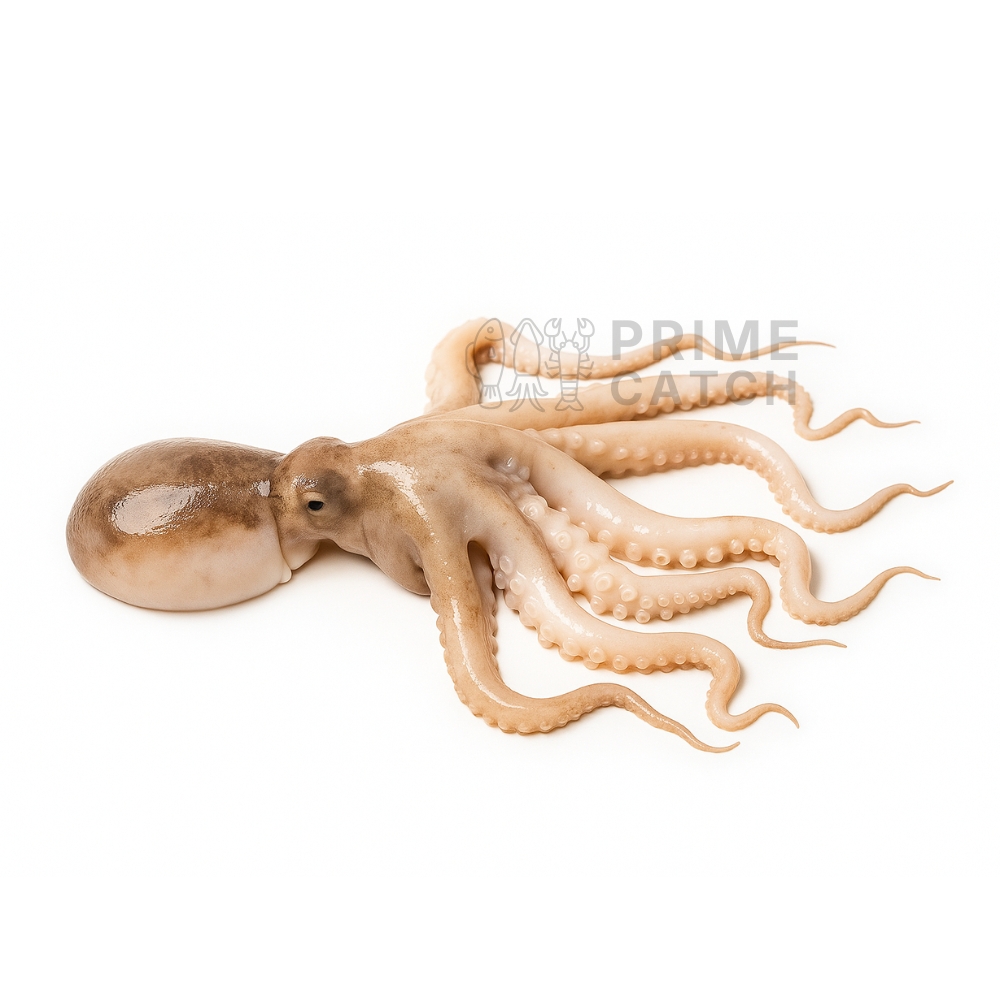
The octopus is one of the most ancient, most intelligent, and most misunderstood creatures in the sea, and in the hands of a kitchen that understands it, one of the most rewarding luxury seafood ingredients in the world.
Octopus vulgaris, the Common Octopus, is not common in any sense that matters. It is found on nearly every warm-water coastline on the planet, yes, but a genuinely fresh, wild-caught specimen handled from the moment of capture with the care this animal demands is a rare thing indeed. Most octopus sold in markets and served in restaurants worldwide is frozen, often heavily treated, and frequently from aquaculture stock. The difference between that product and a fresh, wild-caught Arabian Sea octopus delivered within hours of landing is not subtle. It is fundamental.
At Prime Catch, we source exclusively wild-caught Common Octopus from the rocky shores, coral structures, sandy seabeds, and shallow coastal waters of the Sindh coastline, particularly the productive waters south of Karachi and around Sonmiani Bay, which WWF-Pakistan research identifies as the primary hotspot for this species in Pakistani waters. Landed fresh at Karachi Fish Harbour and delivered without chemical treatment or freezing, our octopus arrives at your kitchen in the condition this extraordinary animal deserves: honest, untreated, and alive with the complex, deeply savoury character that only wild-caught, genuinely fresh product can deliver.
This is an ingredient that rewards patience, technique, and respect. Prime Catch provides the first element. The rest belongs to the cook.
Flavour Profile
The Common Octopus offers a flavour profile of deep, complex, and deeply satisfying character that places it in an entirely different sensory register from the squid, the crab, or any fish in the Prime Catch portfolio.
The meat is white to pale ivory when correctly cooked, with a flavour of remarkable depth and layered complexity: a forward, clean sweetness, a pronounced savoury mid-palate of genuine umami richness, and a long, persistent oceanic finish that carries the unmistakable imprint of a wild animal that spent its life hunting actively in the productive coastal waters of the Arabian Sea. The flavour is concentrated in a way that reflects the octopus’s predatory diet of crabs, molluscs, and small fish, each of which contributes to the characteristic depth and richness of the meat.
The skin, when retained through cooking, adds a further layer of colour, texture, and flavour: a slightly gelatinous, richly savoury outer layer that is an intentional and prized element of the finest Mediterranean octopus preparations. In preparations where the skin is removed after cooking, the clean, white interior meat is exposed in its purest form.
The texture of correctly prepared octopus is one of the great pleasures of the serious seafood table: firm yet tender, with a clean, satisfying chew that gives way to a rich, moist interior without any of the rubberiness that poorly handled or improperly cooked octopus is known for. Achieving this texture requires understanding one of the most important principles in the preparation of this animal: octopus must be tenderised before or during cooking, either through physical action, slow cooking, or marination. A fresh, wild-caught specimen of genuine quality arrives at the kitchen already ahead of a frozen one in this regard, as the cellular integrity of the fresh meat responds more readily and more completely to the tenderising process.
Habitat
Octopus vulgaris is one of the most widely distributed cephalopods in the world’s oceans, found in tropical, subtropical, and temperate coastal waters across the Atlantic, the Mediterranean, and the Indo-Pacific. In Pakistani waters, the species is confirmed as one of the four commercially important octopus species of the coastal fishery, with the highest concentrations south of Karachi and in the Sonmiani Bay area of the Balochistan coastline.
The Common Octopus is a solitary, benthic predator inhabiting the rocky shores, coral reef structures, sandy seabeds, and rubble zones of the shallow coastal shelf from the immediate shoreline to approximately 200 metres depth. It is a creature of den and territory, establishing a home base in a rock crevice, coral hollow, or any suitable shelter from which it hunts actively across a defined territory, feeding on bivalves, crustaceans, and small fish with remarkable intelligence and technique.
The species is a master of camouflage, capable of altering both the colour and the physical texture of its skin within milliseconds to match virtually any substrate. This camouflage ability reflects a neurological sophistication shared by no other invertebrate in the sea and contributes directly to the hunting success that makes the Common Octopus such a nutritionally rich and flavourful table animal.
In Pakistan, the octopus is caught primarily by lured hooks and selective bottom trawls operated by artisanal fishing vessels along the Sindh coastline, with catch landed directly at Karachi Fish Harbour.
Taxonomy
| Classification Level | Detail |
|---|---|
| FAO Name | Common Octopus |
| Scientific Name | Octopus vulgaris (Cuvier, 1797) |
| Common Names | Common Octopus |
| Phylum | Mollusca |
| Class | Cephalopoda |
| Order | Octopoda |
| Family | Octopodidae |
| Genus | Octopus |
| Species | vulgaris |
| IUCN Status | Not Evaluated |
Octopus vulgaris was formally described by the French naturalist Georges Cuvier in 1797 and is the type species of the genus Octopus and arguably the most studied cephalopod in the world. The species name vulgaris derives from the Latin for common, a reference to its wide distribution rather than any suggestion of ordinary quality. The octopus belongs to the class Cephalopoda, the most neurologically advanced class of invertebrate animals, whose members include the squid, the cuttlefish, and the nautilus. Unlike the squid, which has 10 appendages (eight arms and two tentacles), the octopus has eight arms only, from which its order name Octopoda derives. Octopus vulgaris is recognised by WWF-Pakistan research as one of four commercially important octopus species in Pakistani coastal waters, with the south Karachi and Sonmiani Bay areas identified as the primary concentration zones for this species.
Physical Attributes
| Attribute | Detail |
|---|---|
| Body Form | Soft-bodied, with a prominent rounded mantle (head and body) and eight arms equipped with two rows of suckers each |
| Maximum Mantle Length | Approximately 25 cm |
| Maximum Total Length (arm span) | Up to 1 metre |
| Maximum Weight | Up to 10 kg, with common market specimens between 500g and 3 kg |
| Skin | Remarkably variable in colour and texture, capable of instantaneous change from smooth to highly textured in response to environment and mood |
| Arms | Eight equal arms, each with two rows of powerful suckers, significantly stronger in the first pair |
| Ink Sac | Present, containing dark, intensely savoury ink used in classical culinary preparations |
| Beak | Hard, parrot-like beak at the centre of the arms, removed during cleaning |
| Meat Colour (raw) | Pale to white in the mantle, more pigmented in the arms depending on skin |
| Meat Colour (cooked) | White to ivory when skin-off, with a brownish-red skin when retained through cooking |
| Texture (correctly cooked) | Firm, tender, and cleanly chewy with a rich, moist interior |
| Fat Content | Very low, an exceptionally lean cephalopod protein source |
| Available Preparations | Whole · Cleaned Whole · Tentacles |
Preparation Formats
Prime Catch offers the Common Octopus in three internationally recognised preparation formats:
Whole — The octopus as landed: complete, intact, and entirely unprocessed, with the mantle, all eight arms, beak, ink sac, and viscera all present. This is the most versatile format and the one preferred by professional kitchens and experienced cooks who wish to use every element of the animal, including the ink for saucing or flavouring. The Whole format allows complete control over the preparation process and is the correct starting point for the finest slow-cooked and braised preparations where the octopus is cooked in its own juices.
Cleaned Whole — The octopus with the viscera removed, the beak extracted, the eyes trimmed, and the ink sac carefully separated, but with the skin fully intact and all eight arms attached to the head and mantle. This is the internationally standard preparation format for octopus in professional kitchens and premium seafood markets worldwide, the format found at every serious fishmonger from Athens to Tokyo. The Cleaned Whole octopus is ready for the tenderising and cooking process with no further preparation required beyond the chosen method, making it the most practical and most widely applicable format for the serious home kitchen as well as the professional one.
Tentacles — The eight arms of the octopus, separated from the mantle and head, skin on. This is the preferred format for preparations where the arms are the primary eating element, including charcoal-grilling, searing, and composed plating where the visual drama of the individual arm is a deliberate part of the presentation. The octopus arm, correctly grilled or seared, produces one of the most visually striking and most flavourfully concentrated single-component dishes in the entire world of luxury seafood.
A Note on Tenderising
The Common Octopus requires tenderising before or during cooking, and this is not a limitation but a part of the cooking tradition associated with this ingredient across every culture that has made it a staple of the finest seafood table.
The traditional method of the Mediterranean fishing village, beating the fresh octopus against a rock or wooden surface thirty to forty times, breaks down the tough muscle fibres of the arms and mantle before cooking. The modern professional kitchen achieves the same result by freezing and thawing the cleaned octopus, which ruptures the cellular structure and produces tenderness without any physical effort. Prime Catch’s fresh-only product is best tenderised by the traditional method or by a brief period in the freezer followed by a complete thaw before cooking. Slow cooking in a covered pot over very low heat for forty-five minutes to one hour in its own released liquid, without any added water, is the most reliable cooking method for achieving the tender, richly flavoured result that makes this animal so celebrated.
A properly tenderised and correctly cooked Common Octopus is an experience of considerable luxury. The process of getting there is part of what makes it worth having.
Cooking Preferences — International Fine Dining
The Common Octopus is one of the most culturally resonant and technically demanding luxury seafood ingredients in the world, and its finest preparations reflect centuries of accumulated knowledge from the coastal cultures that have built their culinary identities around it.
Europe — Grilled, Braised and Carpaccio: European coastal culinary tradition, particularly in Greece, Italy, Portugal, and Spain, has produced the world’s most celebrated and most technically developed repertoire of octopus preparations. The whole cleaned octopus, slow-cooked in its own liquid until completely tender, then charcoal-grilled over live fire until the skin chars and crisps, is the defining preparation of the Greek island seafood tradition and one of the most beautiful dishes in the Mediterranean canon. Portuguese polvo à lagareiro, in which the tenderised octopus is roasted in the oven with generous quantities of olive oil, garlic, and crushed potatoes, is a dish of extraordinary richness and depth. Octopus carpaccio, thinly sliced cooked tentacle pressed into a cold terrine and served with lemon oil and microgreens, is the contemporary fine dining expression of the same ingredient at its most refined and most visually striking.
The Americas — Grilled, Ceviche-Style and Composed: Across North and South American fine dining, the octopus has achieved a position of considerable prestige in the past two decades, driven by the influence of Mediterranean and Japanese cooking traditions on the American restaurant scene. Charcoal-grilled tentacles, tenderised and pre-cooked, then finished over live fire with olive oil, citrus, and fresh herbs, are a celebrated starter course at the finest coastal restaurants across the region. Latin American ceviches and tiraditos of thinly sliced cooked octopus dressed in citrus, chilli, and coriander are preparations of considerable elegance that have become fixtures on the finest seafood menus from Lima to Mexico City.
East Asia — Takoyaki, Sashimi and Wok-Finished: The octopus is a fundamental ingredient across East Asian culinary culture, and its preparations range from the beloved street food tradition of Japan to the most refined omakase preparations. Takoyaki, small spherical batter-cooked dumplings containing pieces of octopus and dressed with umami-rich sauces and dried bonito flakes, is one of the most beloved casual preparations in Japanese food culture. Raw octopus sashimi, prepared from the tenderest part of the fresh arm, is served at the finest sushi counters and is considered a mark of supreme freshness and quality. Stir-fried octopus with ginger, garlic, and sesame in a hot wok is the East Asian restaurant tradition at its most accessible and most widely reproduced.
South and Southeast Asia — Spiced, Grilled and Masala-Cooked: Across the coastal traditions of South and Southeast Asia, the octopus is a prized and distinctive ingredient of the serious seafood household and coastal restaurant alike. South Indian and Sri Lankan masala preparations, in which cleaned octopus pieces are cooked in a fragrant base of fresh spice, coconut milk, and tamarind, produce a dish of considerable complexity and satisfying richness. Dry-spiced preparations with turmeric, chilli, and curry leaf, cooked over high heat until the octopus caramelises at the edges, are a beloved regional preparation. Grilled tentacles with a coconut and chilli marinade are the live-fire expression of the ingredient at its most dramatic.
The Middle East and Mediterranean — Charcoal-Grilled, Za’atar-Dressed and Slow-Braised: Across the Arabian Gulf and the broader Middle Eastern table, the octopus is a prized luxury ingredient of the finest coastal seafood restaurants, increasingly recognised for both its flavour depth and its visual drama at the table. Whole cleaned octopus, slow-braised in a fragrant broth of olive oil, za’atar, sumac, and preserved lemon, then finished over live charcoal until the skin chars and crisps, produces a preparation of considerable aromatic authority. Individual tentacles, grilled over intense charcoal heat and dressed with pomegranate molasses and fresh herbs, are a composed starter of striking visual and flavour impact that has become a signature of the finest contemporary Gulf seafood restaurants.
General Guidance for Home Preparation: Always tenderise before cooking. The simplest home method is to place the cleaned whole octopus in a covered pot over the lowest possible heat without adding any water. It will release its own liquid within ten minutes. Continue cooking, covered, for forty-five minutes to one hour until a skewer passes through the thickest part of an arm with no resistance. Remove from the liquid and allow to cool. At this point the octopus can be grilled, sliced, or used in any preparation. The cooking liquid is intensely flavoured and should never be discarded: it is the foundation of an exceptional sauce or broth. Do not rush the tenderising process. Patience is the single most important ingredient in cooking octopus well.
Health Benefits
The Common Octopus presents a nutritional profile of exceptional clinical significance, combining extraordinary lean protein density with one of the most impressive mineral profiles of any seafood species, including some of the highest bioavailable copper concentrations of any food available.
High-Quality Complete Protein — Exceptionally Lean and Dense The Common Octopus delivers approximately 14 to 18 grams of complete protein per 100 grams of edible meat at a very low caloric density, containing all nine essential amino acids in optimal biological ratios. Its combination of high protein quality, very low fat, and exceptional mineral density makes it one of the most nutritionally complete luxury seafood choices available. Reference: WebMD — Health Benefits of Octopus
Copper — The Most Concentrated Dietary Source Available The Common Octopus is among the single richest whole-food sources of copper available in any culinary tradition, with concentrations that are nutritionally significant even in modest serving sizes. Copper is essential for iron metabolism, neurological function, connective tissue formation, immune system health, and the activity of several critical antioxidant enzymes. A standard serving of octopus provides a substantial proportion of the recommended daily intake for this frequently under-consumed mineral. Reference: Harvard Health Publishing — Important Minerals
Vitamin B12 — Among the Richest Sources Available Cephalopods are among the most concentrated whole-food dietary sources of Vitamin B12, and the Common Octopus is particularly rich in this critical nutrient. A standard serving provides well above the recommended daily intake for Vitamin B12, essential for neurological function, red blood cell formation, and DNA synthesis. Reference: Mayo Clinic — Vitamin B12
Omega-3 Fatty Acids — Cardiovascular and Cognitive Support The Common Octopus provides meaningful concentrations of EPA and DHA omega-3 fatty acids as a proportion of its total lipid content, contributing to cardiovascular protection, systemic inflammation reduction, and neurological health maintenance despite its very low overall fat content. Reference: Harvard Health Publishing — Omega-3 Fatty Acids: An Essential Contribution
Selenium — Antioxidant Defence and Thyroid Support The Common Octopus is a very significant dietary source of selenium, the trace mineral essential for oxidative free radical defence, immune system regulation, and thyroid hormone synthesis, at concentrations that make a standard serving a clinically substantial dietary contribution. Reference: Mayo Clinic — Selenium
Iron — Haematological Health and Energy Metabolism The Common Octopus is a meaningful source of dietary iron, the mineral essential for haemoglobin synthesis, oxygen transport, and cellular energy metabolism. The combination of iron and copper in octopus is of particular clinical significance, as copper plays a direct role in the bioavailability of dietary iron. Reference: Harvard Health Publishing — Iron
Exceptionally Low in Fat and Calories — Precision Nutrition The Common Octopus is one of the leanest animal proteins available in any culinary tradition, essentially negligible in saturated fat and very modest in total caloric density, making it an ideal choice for those managing cardiovascular health, body composition, or metabolic conditions without any compromise on flavour depth or nutritional quality. Reference: Mayo Clinic — Dietary Fats
A Note on Prime Catch Standards
Every Common Octopus bearing the Prime Catch name is:
- Wild-caught from the rocky coastal waters and sandy seabeds of the Arabian Sea coastline, principally south of Karachi and around Sonmiani Bay
- Fresh, never frozen — the standard of particular significance for this species, whose tenderising response and flavour integrity are directly dependent on the cellular condition of the fresh meat
- Chemical-free — zero preservative treatment of any kind
- Available in three preparation formats — Whole, Cleaned Whole, and Tentacles, to suit every kitchen and every preparation tradition
- Priced per kilogram across all formats
Prime Catch. For those who accept no substitution.
Reviews
There are no reviews yet.