
Introduction
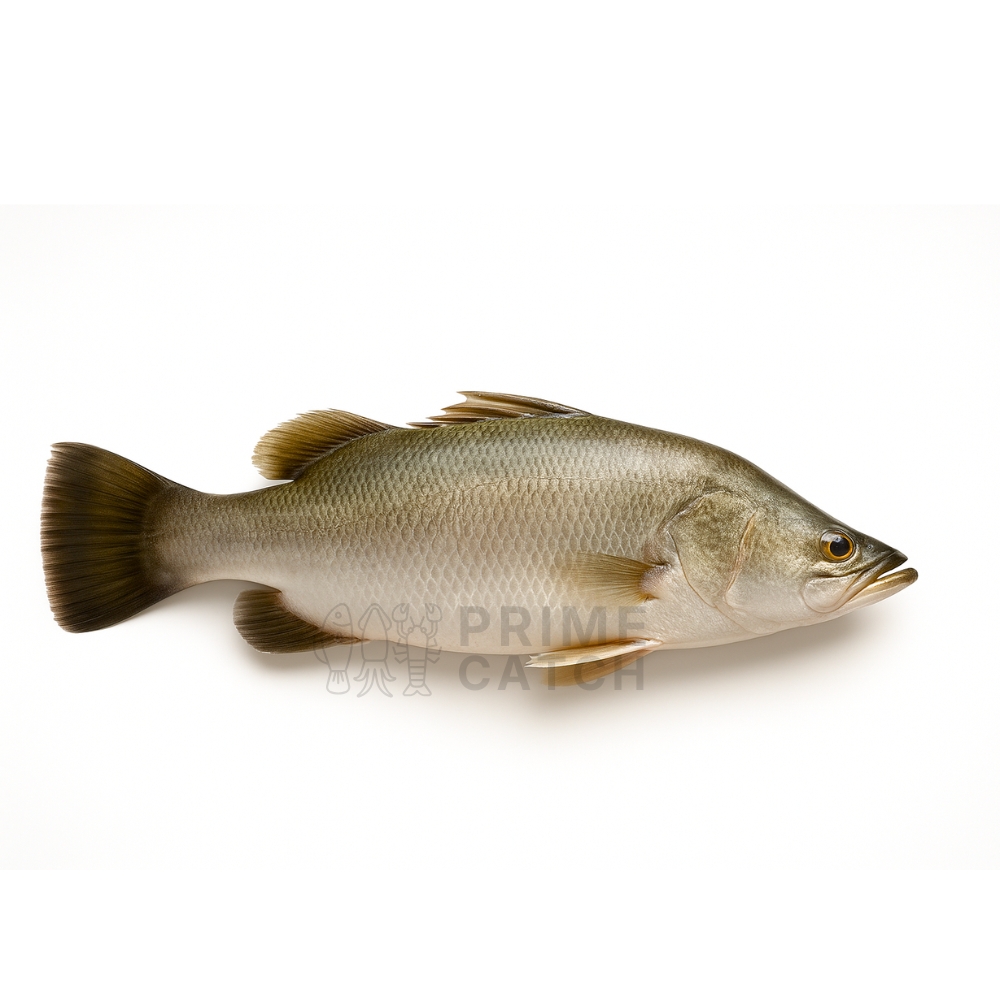
In Australia they call it Barramundi, a name borrowed from the Nyuyul language of Queensland meaning large-scaled river fish. In Southeast Asia it is simply Seabass, the fish that fills the tanks of the finest seafood restaurants from Singapore to Bangkok and commands prices that reflect exactly what the market understands it to be worth. Across the Indo-Pacific, Lates calcarifer is one of the most celebrated, most versatile, and most widely farmed luxury fish in the world.
And that is precisely the point.
Almost every Barramundi sold commercially, in restaurants, in premium supermarkets, at fish markets from Dubai to Sydney, is farmed. The species’ tolerance of crowded conditions, its rapid growth rate, and its adaptability to freshwater, brackish, and marine environments have made it one of the most intensively aquacultured fish on the planet. Farmed Barramundi is an excellent product. But wild-caught Barramundi, drawn from the natural coastal and estuarine waters it has inhabited for millennia, is a different fish entirely.
At Prime Catch, our Asian Seabass is wild-caught from the coastal zones, tidal estuaries, mangrove creek systems, and nearshore marine waters of the Sindh and Balochistan coastlines, where Lates calcarifer moves freely between the freshwater, brackish, and open-sea environments that define its remarkable euryhaline life cycle. These fish are not raised in nets or fed on processed pellets. They are caught at the point in their natural life cycle when flavour, flesh density, and size are at their most exceptional, by fishing operations that land their catch directly at Karachi Fish Harbour.
This is one of the rarest sourcing claims in the global Barramundi market. Prime Catch makes it honestly, and the difference is in every bite.
Flavour Profile
The Asian Seabass is a fish of considerable flavour refinement, and wild-caught specimens from natural estuarine and coastal environments offer a character that the finest farmed product simply cannot replicate.
The flesh is white, firm, and moderately fatty, with a flavour profile of clean, sweet mildness that carries an underlying richness entirely its own. The dominant note is a gentle, oceanic sweetness with a soft, buttery mid-palate quality derived from the species’ moderate natural fat content and its varied, carnivorous diet in the productive coastal and estuarine ecosystems of the Arabian Sea. The flavour is clean, satisfying, and entirely free of any assertive fishiness, producing a fish that is simultaneously accessible to those who do not consider themselves dedicated seafood enthusiasts and deeply rewarding to those who are.
The catadromous life history of this species, in which it moves between freshwater, brackish estuaries, and open marine waters in the course of its development, contributes a subtle, layered complexity to the flavour of wild specimens that is absent in farmed fish held in constant salinity environments. Wild Barramundi caught at the transition between estuarine and marine life stages carry an almost mineral freshness alongside their characteristic sweetness, a quality that experienced seafood professionals describe as the clearest marker of a genuinely wild-caught specimen.
The texture is where the Asian Seabass earns its global reputation: firm, large-flaked, and structured with the density of an active, predatory fish, yet yielding and moist at the point of eating. It holds together perfectly under high heat, refuses to break apart under aggressive cooking methods, and produces a skin that, when correctly crisped, is widely regarded as one of the finest skin-on cooking experiences available in any white fish. The skin of the Barramundi is a dish in itself: thick, richly flavoured, and capable of developing a crackling, deeply golden finish that defines the species’ most celebrated preparations.
Habitat
Lates calcarifer is a euryhaline, catadromous species with a natural distribution extending across the Indo-West Pacific from the Arabian Gulf and the western coast of India through Southeast Asia, Papua New Guinea, and northern Australia. In Pakistani waters, the species occupies the full range of its characteristic habitats: the mangrove-fringed tidal creek systems and estuaries of the Indus Delta, the brackish coastal lagoons and tidal flats of the Sindh coastline, and the nearshore marine environments where adult fish move to complete their life cycle.
The catadromous life history of the Asian Seabass is one of the most distinctive of any commercial fish species. Juveniles recruit from estuarine spawning grounds into freshwater and brackish habitats where they develop in the protection of mangroves and tidal creeks. As they mature, they progressively migrate into higher-salinity coastal and marine environments, where adults reach their maximum size and flavour development before returning to estuarine and coastal zones for spawning. This migration between environments of varying salinity, temperature, and food availability produces the characteristic flavour complexity and flesh density that distinguishes wild-caught specimens from fish held in constant aquaculture conditions.
Prime Catch sources wild-caught Asian Seabass from artisanal and semi-industrial fishing operations targeting the species in its natural coastal and estuarine habitats along the Sindh and Balochistan coastlines, with all catch landed directly at Karachi Fish Harbour.
Taxonomy
| Classification Level | Detail |
|---|---|
| FAO Name | Barramundi |
| Scientific Name | Lates calcarifer (Bloch, 1790) |
| Common Names | Asian Seabass, Barramundi, Giant Sea Perch, Silver Barramundi |
| Phylum | Chordata |
| Class | Actinopterygii |
| Order | Perciformes |
| Family | Centropomidae |
| Genus | Lates |
| Species | calcarifer |
| FAO Species Code | SBR |
| IUCN Status | Not Evaluated |
Lates calcarifer was formally described by the German naturalist Marcus Elieser Bloch in 1790. The species name calcarifer derives from the Latin calcar, meaning spur, and ferre, meaning to bear, a reference to the prominent spine on the fish’s preopercular bone. It belongs to the family Centropomidae, a lineage of large, predatory, euryhaline fish that includes the snooks of the Americas and the perches of the Indo-Pacific. The species is known by two primary common names in the English-speaking world: Barramundi in Australia, where it is the most celebrated native food fish, and Asian Seabass across its range in Asia, where it has been central to the regional seafood trade for centuries.
Physical Attributes
| Attribute | Detail |
|---|---|
| Body Form | Large, elongated, robust with a concave head profile, large upturned mouth, and powerful, rounded caudal fin |
| Maximum Length | Up to 180 cm total length |
| Common Market Length | 40 to 80 cm |
| Common Market Weight | 1.5 to 8 kg |
| Body Colour | Silver to golden-green dorsally, fading to silver-white on the flanks and belly, with large, distinctive scales |
| Flesh Colour (raw) | Bright white to pale ivory, firm and moderately fatty |
| Flesh Colour (cooked) | Clean white, large-flaked and moist |
| Texture (raw) | Firm, dense, large-flaked with the structure of an active predatory fish |
| Texture (cooked) | Moist, substantial, and cleanly flaking in large cohesive segments |
| Fat Content | Moderate, producing the characteristic buttery richness and moisture retention |
| Skin | Thick, firm, and large-scaled, producing one of the most celebrated skin-crisp preparations of any white fish species |
| Eyes (freshness indicator) | Bright, clear, and convex on Prime Catch-grade specimens |
| Gills (freshness indicator) | Deep red, the primary freshness indicator |
| Available Preparations | Whole Round · Whole Gutted and Cleaned Head-On · Headless Gutted and Cleaned · Bone-In Steaks · Boneless Fillet Skin-On |
Preparation Formats
Prime Catch offers the Asian Seabass in five internationally recognised preparation formats, priced per kilogram:
Whole Round — The fish as landed from the coastal and estuarine waters of the Arabian Sea: whole, ungutted, and entirely intact. The definitive format for freshness verification, with eyes, gills, skin condition, and belly all immediately assessable. Preferred by professional kitchens and experienced home cooks who wish to begin preparation from the most pristine possible starting point.
Whole Gutted and Cleaned, Head-On — Eviscerated, cleaned, and rinsed with head and tail fully intact. The standard whole-fish format for roasting, steaming, and large-format grilling. The head and collar of the Asian Seabass are particularly prized for their gelatinous richness in East Asian cooking traditions, and are retained in this format for precisely that reason.
Headless Gutted and Cleaned — Gutted, cleaned, and head-removed. A practical format that retains the full flesh section from collar to tail, preferred by those managing the fish’s considerable size in a domestic kitchen without sacrificing any of the prime flesh.
Bone-In Steaks, Cross-Cut — The whole fish cross-cut into uniform transverse steaks of consistent thickness, each retaining the skin, the central bone structure, and the full flavour of the fish. The Asian Seabass’s thick, flavourful skin and firm flesh make bone-in steaks one of the most rewarding preparations of this species for grilling and shallow-frying.
Boneless Fillet, Skin-On — The prime fillet section, carefully hand-cut from the bone with skin intact and trimmed to a clean, consistent format. This is the preparation that has made the Asian Seabass one of the most sought-after fish in professional kitchens worldwide. The skin of the Barramundi, seared correctly over high heat, produces a crackling, deeply golden surface of extraordinary flavour that defines the species’ most celebrated restaurant presentations globally.
Cooking Preferences — International Fine Dining
The Asian Seabass is one of the great all-purpose luxury fish of the contemporary fine dining world, celebrated across every culinary tradition that has encountered it for the combination of a firm, clean white flesh and a skin that, when properly crisped, delivers a textural and flavour experience unlike any other white fish available.
Europe — The Skin-Crisp Fillet: European fine dining’s defining preparation of the Asian Seabass is one of the most technically precise and most visually arresting dishes in the restaurant kitchen repertoire. The boneless skin-on fillet, placed skin-side down in a thoroughly preheated pan with a small amount of clarified butter or neutral oil, pressed gently for the first thirty seconds, and cooked for 70 to 80 percent of its total time on the skin side, emerges with a skin of extraordinary crackling crispness and a flesh that is just set, moist, and richly buttery. Plated skin-side up with a beurre blanc, a light herb nage, or a simple lemon butter, it is a dish of considerable elegance and genuine technical achievement. Whole roasting with fennel, citrus, and cold-pressed olive oil is the Sunday centrepiece expression of this fish at its most relaxed and most impressive.
The Americas — Grilled, Blackened and Raw: Across North and South American fine dining, the Asian Seabass occupies a position of growing prestige as awareness of its qualities spreads through the restaurant community. The skin-on fillet, grilled over live hardwood charcoal until the skin chars and crisps, is a preparation of considerable drama and flavour intensity. Blackened preparations with a bold spice crust applied to the skin side produce a deeply caramelised exterior that showcases the species’ fat content at its most expressive. Latin American preparations of thinly sliced raw fillet dressed in citrus, chilli, and aromatics showcase the clean, sweet quality of a truly fresh wild specimen with considerable elegance.
East Asia — Whole Steamed, Wok-Finished and Crispy Skin: The Asian Seabass is a deeply familiar and highly prized fish across East Asian culinary tradition. In Cantonese kitchens, whole steaming over fragrant ginger water, finished with hot oil, julienned spring onion, and premium aged soy sauce, is the preparation most closely associated with this species and the one that most clearly reveals the quality of a genuinely fresh, wild-caught specimen. The skin-on fillet, wok-seared until the large scales crisp to a golden, crackling finish, then dressed with a ginger-scallion oil, is the contemporary fine dining expression of the same tradition. In Singapore and Malaysia, the Asian Seabass holds an iconic status in the regional cuisine that gives its finest preparations a cultural resonance entirely beyond their technical merit.
South and Southeast Asia — Spiced, Grilled and Coconut-Enriched: Across the coastal traditions of South and Southeast Asia, the Asian Seabass occupies a position of considerable prestige at the luxury seafood table. Whole grilling over live coals, scored and marinated in turmeric, chilli, lemongrass, and coconut milk, produces a fish of extraordinary aromatic richness. Bone-in steaks, shallow-fried in spiced oil to a golden crust, represent the most domestically beloved format across the region. The boneless skin-on fillet, marinated in a fresh herb and chilli paste and grilled over live coals, is the refined contemporary expression of the regional tradition at its most elevated. In Thailand, the whole fish deep-fried and dressed with a fragrant sweet chilli and Thai basil sauce is one of the most celebrated preparations of this species in the entire regional culinary canon.
The Middle East and Mediterranean — Charcoal-Grilled, Za’atar-Rubbed and Whole-Presented: Across the Arabian Gulf and the broader Middle Eastern seafood table, the Asian Seabass is a fish of growing recognition and genuine prestige, increasingly present at the finest fish restaurants from Abu Dhabi to Beirut. Whole charcoal-grilling, marinated in za’atar, sumac, olive oil, and preserved lemon, produces a fish of considerable aromatic authority with the firm flesh and thick, caramelised skin that live-fire cooking rewards most fully. Bone-in steaks, shallow-fried in spiced oil and served alongside fragrant rice, are a natural fit for the regional seafood table. The boneless skin-on fillet, oven-roasted with pomegranate molasses and fresh herbs, is the refined contemporary expression of the regional tradition.
General Guidance for Home Preparation: The skin is the most important element of this fish in most preparations and it deserves careful attention. Ensure the skin is thoroughly dry before it meets the pan: pat it firmly with kitchen paper and allow the fillet to rest uncovered at room temperature for fifteen minutes before cooking. A thoroughly preheated, heavy-based pan is essential. Place the fillet skin-side down, press gently for thirty seconds to prevent curling, then leave it undisturbed. The fillet is ready to turn when it releases naturally from the pan surface. Cook 70 to 80 percent of the total time on the skin side. For whole fish, score deeply three to four times per side before cooking.
Health Benefits
The Asian Seabass presents a nutritional profile of genuine clinical significance, combining the lean protein credentials of a white fish with a moderate fat content that delivers meaningful omega-3 concentrations and exceptional fat-soluble vitamin availability.
High-Quality Complete Protein — Substantial and Versatile The Asian Seabass delivers approximately 20 to 25 grams of complete protein per 100 grams of edible flesh, containing all nine essential amino acids in optimal biological ratios. Its moderate fat content gives the flesh a richness and satiety value that distinguishes it from leaner white fish species, making a single fillet or steak portion a genuinely satisfying and nutritionally complete meal. Reference: WebMD — Health Benefits of Fish
Omega-3 Fatty Acids — Cardiovascular and Cognitive Protection As a wild-caught, carnivorous predator feeding on a varied natural diet of fish and crustaceans in the productive coastal and estuarine environments of the Arabian Sea, the Asian Seabass accumulates meaningful concentrations of EPA and DHA, the long-chain omega-3 fatty acids with the strongest clinical evidence base for cardiovascular protection, systemic inflammation reduction, and neurological health maintenance. Wild-caught specimens consistently exhibit superior omega-3 profiles compared to farmed alternatives fed on processed diets. Reference: Harvard Health Publishing — Omega-3 Fatty Acids: An Essential Contribution
Vitamin D — A Meaningful Dietary Source The Asian Seabass’s moderate fat content makes it a more significant whole-food dietary source of Vitamin D than purely lean white fish species, providing a fat-soluble vitamin essential for calcium absorption, bone density, immune function, and mood regulation that is broadly deficient in the diets of urban populations with limited sun exposure. Reference: Harvard Health Publishing — Vitamin D and Your Health
Selenium — Antioxidant Defence and Thyroid Support The Asian Seabass is a meaningful dietary source of selenium, the trace mineral essential for oxidative free radical defence, immune system regulation, and thyroid hormone synthesis. A standard serving provides a clinically significant proportion of the recommended daily intake. Reference: Mayo Clinic — Selenium
Phosphorus — Bone Mineralisation and Cellular Energy The Asian Seabass is a concentrated source of phosphorus, the mineral second only to calcium in bone and dental mineralisation and essential for cellular energy metabolism through its central role in ATP synthesis. Reference: Harvard Health Publishing — Phosphorus in Your Diet
Vitamin B12 — Neurological and Haematological Health Marine fish are among the richest whole-food sources of Vitamin B12, essential for neurological function, red blood cell formation, and DNA synthesis. The Asian Seabass provides this critical nutrient at concentrations that make a standard serving a meaningful daily contribution. Reference: Mayo Clinic — Vitamin B12
Iodine — Thyroid and Metabolic Regulation As a wild euryhaline species inhabiting the iodine-rich coastal and marine waters of the Arabian Sea, Lates calcarifer accumulates dietary iodine at levels of genuine clinical significance, supporting healthy thyroid function, metabolic regulation, and neurological development. Reference: Harvard Health Publishing — Iodine Deficiency
A Note on Prime Catch Standards
Every Asian Seabass bearing the Prime Catch name is:
- Wild-caught from the coastal and estuarine waters of the Arabian Sea coastline, a genuine rarity in a global market dominated by farmed product
- Fresh, never frozen — landed at Karachi Fish Harbour and delivered within hours
- Chemical-free — zero preservative treatment of any kind
- Sourced from natural habitat — fish that have completed their catadromous life cycle in the mangrove, estuarine, and coastal marine environments of the Sindh and Balochistan coastlines
- Available in five preparation formats — from Whole Round to Boneless Fillet Skin-On — to suit every kitchen and every occasion
- Priced per kilogram across all preparation formats
Prime Catch. For those who accept no substitution.

Reviews
There are no reviews yet.