
Introduction
Some fish are known to the world. Others are known only to those who have sought them out.
The Cobia belongs firmly in the second category, and it is perhaps the finest argument that exists for the rewards of looking beyond the familiar. Rachycentron canadum is not a fish that announces itself loudly. It carries no borrowed prestige, no global marketing apparatus, no supermarket ubiquity. What it carries instead is a flesh of extraordinary quality that experienced seafood cultures, serious anglers, and the finest chefs who have worked with it consistently describe in the same terms: firm, rich, buttery, and entirely unlike anything else in the water.
At Prime Catch, we source exclusively wild-caught Cobia from the coastal and offshore waters of the Arabian Sea, where this species is an established and valued component of the demersal fish community along the Sindh and Balochistan coastlines. The Arabian Sea’s relationship with the Cobia goes deeper than most people know: in 2024, marine biologists from the University of Karachi’s Centre of Excellence in Marine Biology identified two entirely new species of Cobia off the Gwadar coast, Rachycentron blochii and Rachycentron makranensis, the first new members of this family to be described since the genus was established. It was a discovery that confirmed what serious seafood people in this region have long understood: the Arabian Sea is a biologically exceptional body of water, and the fish it produces are of a standard the world has not fully reckoned with.
Our Cobia is landed fresh at Karachi Fish Harbour, handled without chemical treatment, and delivered without the compromise of freezing. It arrives as it left the water: in a condition of absolute, unadulterated freshness, ready for whatever the kitchen demands of it.
Flavour Profile
The Cobia is a fish that consistently surprises. Clients who encounter it for the first time frequently remark that it does not taste like what they expected a fish to taste. What they mean is that it is richer, more substantial, and more satisfying than almost any other white-fleshed species they have encountered, while remaining entirely clean and free of any heaviness or oiliness.
The flesh is white to pale ivory, firm, and moderately fatty in a way that is immediately apparent in the eating rather than in any description of the fish. The dominant flavour note is a clean, deep oceanic sweetness with a savoury richness in the mid-palate that speaks directly to the species’ predatory diet of crustaceans, benthic invertebrates, and smaller fish. The fat content is higher than most white fish, but it is distributed through the flesh in a way that produces moisture and richness rather than any sense of greasiness, giving the Cobia a buttery, almost unctuous quality that very few fish in the same weight class can match.
The texture is among the firmest and most satisfying of any species Prime Catch offers: dense, large-flaked, and structured with the muscle density of an active, pelagic predator. It holds together beautifully under every cooking method from the gentlest steam to the most aggressive grill, resisting the tendency to fall apart or dry out that afflicts leaner, less fatty species under the same conditions. It also accepts marinades and aromatics with exceptional generosity, making it one of the most rewarding fish to work with across the full range of the world’s great seafood culinary traditions.
Habitat
Rachycentron canadum has one of the widest distributions of any large pelagic fish in the world, found in the warm temperate to tropical coastal waters of the Atlantic, the Indian Ocean, and the western Pacific. In the Arabian Sea, the species inhabits the coastal and offshore zones of the Sindh and Balochistan coastlines, favouring the warm, productive waters associated with reef structures, offshore rocky outcrops, coastal estuaries, and the mid-shelf environments at depths ranging from approximately 10 to 75 metres.
The Cobia is a highly migratory, pelagic species with a strong association with floating objects, offshore structures, and the shadow of large marine animals, including rays and sharks, which it is known to follow in open water. It is a carnivorous apex predator feeding predominantly on crustaceans, squid, and benthic fish, with a foraging style that takes it across a wide range of coastal and offshore habitats in the course of a single season. This varied, high-energy lifestyle in the nutrient-rich waters of the Arabian Sea is the direct source of the firm muscle density and rich, fatty flavour that sets it apart from every other species in these waters.
The recent discovery of two new Cobia species off Gwadar, confirmed by peer-reviewed research from the University of Karachi published in 2024, establishes the northern Arabian Sea as a region of unique biological significance for this family, and lends Prime Catch’s Arabian Sea Cobia a provenance story that no other fishery in the world can currently match.
Prime Catch sources from hook-and-line and gillnet operations along the Sindh and Balochistan coastline, with all catch landed directly at Karachi Fish Harbour.
Taxonomy
| Classification Level | Detail |
|---|---|
| FAO Name | Cobia |
| Scientific Name | Rachycentron canadum (Linnaeus, 1766) |
| Common Names | Cobia, Black Kingfish, Lemonfish, Black Salmon, Crabeater, Ling |
| Phylum | Chordata |
| Class | Actinopterygii |
| Order | Carangiformes |
| Family | Rachycentridae |
| Genus | Rachycentron |
| Species | canadum |
| FAO Species Code | RCN |
| IUCN Status | Least Concern |
Rachycentron canadum was formally described by the Swedish naturalist Carl Linnaeus in 1766 and holds a position of unique distinction in the classification of marine fish: it is the only species in its genus and the only species in the entire family Rachycentridae, making it one of the most taxonomically singular fish in the world ocean. The recent 2024 discovery of two additional Rachycentron species off Gwadar, Pakistan, the first new members of this family ever described, has expanded this remarkable lineage and placed the Arabian Sea at the centre of its scientific story.
Physical Attributes
| Attribute | Detail |
|---|---|
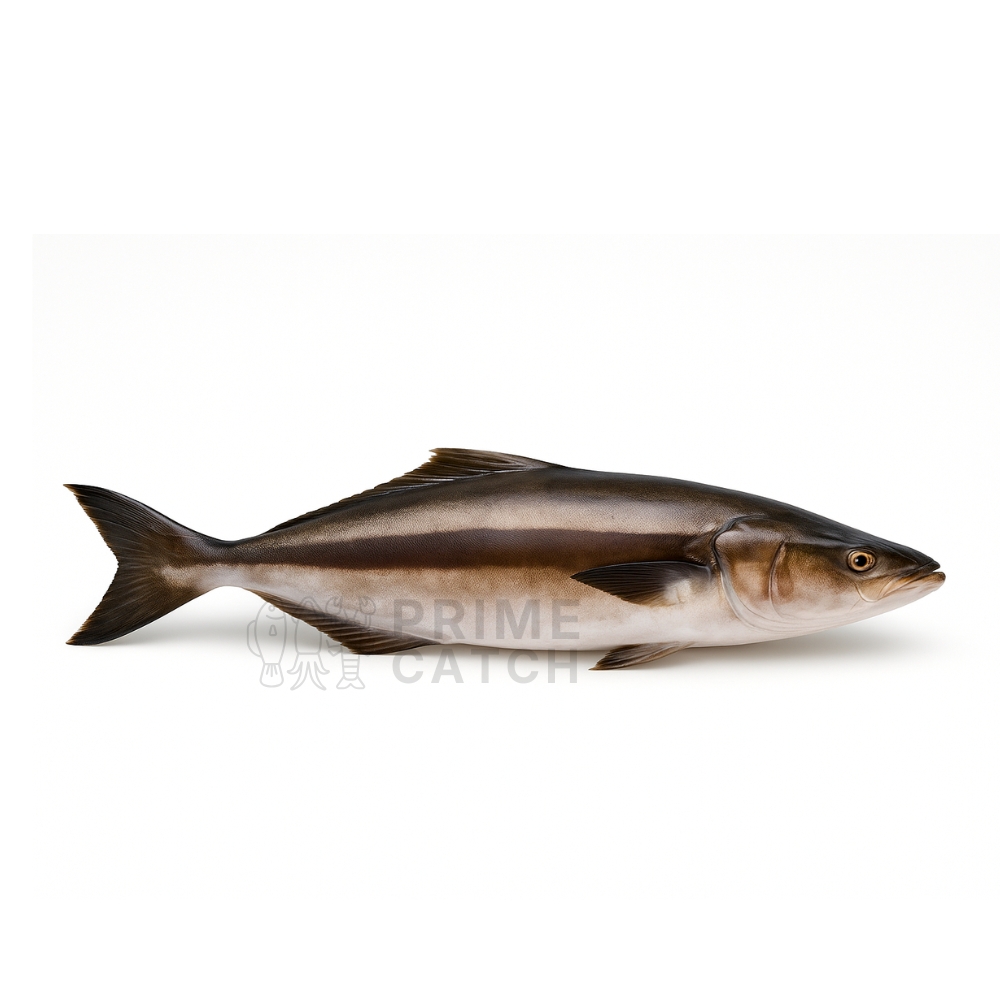
| Body Form | Long, cylindrical, and powerfully built, with a flattened head and a distinctive shark-like profile |
| Maximum Length | Up to 200 cm |
| Maximum Weight | Over 68 kg, with common market specimens between 5 and 25 kg |
| Body Colour | Dark brown to charcoal dorsally, with two distinctive pale silver to white lateral stripes running the full length of the body |
| Flesh Colour (raw) | White to pale ivory, firm and moderately fatty |
| Flesh Colour (cooked) | Clean white, large-flaked, moist and richly yielding |
| Texture (raw) | Firm, dense, and finely structured with a large natural flake |
| Texture (cooked) | Buttery, moist, and cleanly separating in large cohesive segments |
| Fat Content | Moderate to high by white fish standards, producing the characteristic richness and moisture retention |
| Skin | Firm and well-pigmented with the characteristic dark brown and silver stripe colouration, excellent for skin-on preparations |
| Eyes (freshness indicator) | Bright, clear, and convex on Prime Catch-grade specimens |
| Gills (freshness indicator) | Deep red, the primary freshness indicator |
| Available Preparations | Whole Round · Whole Gutted and Cleaned Head-On · Headless Gutted and Cleaned · Bone-In Steaks · Boneless Fillet Skin-On |
Preparation Formats
Prime Catch offers the Cobia in five internationally recognised preparation formats, priced per kilogram:
Whole Round — The fish as landed from the Arabian Sea: whole, ungutted, and entirely intact. The definitive format for freshness verification, with eyes, gills, and flesh colour all immediately assessable. Suited to professional kitchens and experienced home cooks who prefer to begin preparation at the most pristine possible starting point.
Whole Gutted and Cleaned, Head-On — Eviscerated, cleaned, and rinsed with head and tail fully intact. The complete fish in table-ready condition, suited to whole roasting, grilling, or large-format presentation. The Cobia’s cylindrical body makes it an exceptionally well-proportioned whole-roast fish for a substantial dinner gathering.
Headless Gutted and Cleaned — Gutted, cleaned, and head-removed. A practical format that eliminates the head while retaining the full flesh body, making the fish considerably more manageable in a domestic kitchen while preserving all of the prime flesh from collar to tail.
Bone-In Steaks, Cross-Cut — The whole fish cross-cut into uniform transverse steaks of consistent thickness. Each steak retains the skin, the central bone structure, and the full flavour of the fish. The Cobia’s cylindrical body produces particularly clean, symmetrical steaks of consistent size and weight, making this the most practical and most popular preparation format for everyday home cooking and grilling.
Boneless Fillet, Skin-On — The prime fillet section, carefully hand-cut from the bone with skin intact and trimmed to a clean, presentation-ready format. The Cobia’s generous body depth and firm flesh produce fillets of considerable substance and visual presence. The professional kitchen’s preferred format for pan-searing, grilling, and composed plating, where the crisped skin provides both a textural contrast and a flavour dimension of genuine significance.
Cooking Preferences — International Fine Dining
The Cobia’s firm, buttery flesh, moderate fat content, and exceptional tolerance of a wide range of cooking methods make it one of the most broadly capable luxury fish for the serious kitchen. It performs equally well in the gentlest preparations and the most aggressive, retaining its moisture and structural integrity across conditions that would compromise a less robust species.
Europe — Pan-Seared, Butter-Basted and Classically Composed: In European fine dining, the Cobia’s richness of flesh and firm structure position it alongside the turbot and the sea bass as one of the great white fish of the luxury plate. The skin-on fillet, seared in clarified butter with the skin pressed firmly against a hot pan, crisps to a deeply flavoured, golden surface while the interior remains moist and buttery. Basting with brown butter and fresh thyme during cooking produces an extraordinary aromatic richness that the Cobia’s fat content carries with remarkable elegance. Whole roasting with fennel, citrus, and cold-pressed olive oil is a Provençal preparation of considerable beauty, and the fish’s cylindrical form makes it one of the most visually impressive whole-roast presentations available.
The Americas — Blackened, Grilled and Sushi-Grade Raw: Across North American fine dining, the Cobia is considered one of the most exciting underutilised luxury fish available, with chefs who have worked with it consistently championing its quality above better-known species. Blackened over intense heat with a bold spice crust, the rich, fatty flesh produces a caramelised exterior of extraordinary depth while the interior remains moist and yielding in a way that leaner fish cannot match. The Cobia is also one of the few white-fleshed species considered entirely appropriate for raw preparations: thinly sliced as carpaccio or crudo, dressed simply with cold-pressed olive oil, sea salt, and citrus, it reveals a clean, subtly sweet flavour of genuine sashimi-grade quality.
East Asia — Steamed, Grilled and Raw: The Cobia’s clean flavour, firm flesh, and moderate fat content make it a well-regarded species in East Asian seafood markets, where it is increasingly recognised as a premium alternative to the grouper for whole steaming preparations. Whole steaming over ginger-infused water, finished with cascading hot oil and aged soy sauce, produces a dish of considerable delicacy when the specimen is of Prime Catch’s freshness standard. The skin-on fillet, seared skin-side down in a hot pan and finished with a light ponzu and ginger dressing, is the contemporary fine dining expression of the same tradition. In the most elevated Japanese preparations, the freshest Cobia is served as sashimi, its moderate fat content producing a clean, buttery eating experience that places it in the upper tier of white-fleshed sashimi fish.
South and Southeast Asia — Spiced, Coconut-Enriched and Live-Fire: Across the coastal traditions of South and Southeast Asia, the Cobia is a prized catch of the serious seafood household. Its generous fat content makes it uniquely well-suited to bold, aromatic spicing treatments, carrying turmeric, chilli, and fresh coriander with a richness and depth that leaner fish cannot provide. Bone-in steaks, marinated and shallow-fried to a deep golden crust, are a celebrated domestic preparation of this fish across the region. Coconut milk curries built on Cobia loin cubes, light tamarind broths, and mustard-seed-tempered dry preparations all showcase the species’ fat-enriched flesh in distinctly regional ways of considerable sophistication.
The Middle East and Mediterranean — Charcoal-Grilled, Za’atar-Rubbed and Whole-Presented: Across the Arabian Gulf and the broader Middle Eastern seafood table, the Cobia is a familiar and highly regarded species at the finest fish markets and seafood restaurants from Muscat to Doha. Whole charcoal-grilling, marinated in cumin, coriander, dried lemon, and herb-infused olive oil, produces a fish of extraordinary aromatic richness, with the moderate fat content basting the flesh from within as the exterior caramelises over the coals. Bone-in steaks, shallow-fried in spiced oil and served alongside aromatic rice, represent the most domestically beloved format. The boneless fillet, oven-roasted with za’atar and pomegranate molasses, is the refined contemporary expression of the regional tradition at its finest.
General Guidance for Home Preparation: The Cobia’s fat content is its greatest cooking advantage: it is far more forgiving of slight overcooking than leaner white fish species, and it actively benefits from methods that would dry out a less fatty fish. That said, the ideal internal temperature for a cooked Cobia steak or fillet is still a moment before fully set, when the flesh is just beginning to flake but retains a hint of translucency at the thickest point. For bone-in steaks, allow 4 to 5 minutes per side over high heat. For fillets, 70 percent of the cooking time skin-side down produces the skin crisp this cut deserves. Season generously and do not be afraid of bold aromatics: this fish can carry them.
Health Benefits
The Cobia presents a nutritional profile of particular distinction within the white fish category, combining the lean protein credentials of a white-fleshed species with a fat content that is meaningfully higher than most of its peers, delivering a richer omega-3 profile and a caloric satisfaction that purely lean fish cannot match.
High-Quality Complete Protein — Substantial and Satiating Cobia delivers approximately 20 to 26 grams of complete protein per 100 grams of edible flesh, containing all nine essential amino acids in optimal biological ratios. Its moderate fat content gives the flesh a richness and satiety value that purely lean fish species cannot match, making a single steak or fillet portion a genuinely satisfying and nutritionally complete meal. Reference: WebMD — Health Benefits of Fish
Omega-3 Fatty Acids — Cardiovascular and Cognitive Protection The Cobia’s moderate to high fat content by white fish standards translates directly into a meaningful omega-3 profile. As a wild-caught marine predator feeding on crustaceans, squid, and pelagic fish, it accumulates EPA and DHA at concentrations significantly above those of leaner white fish, placing it among the more omega-3-significant white-fleshed species available. Reference: Harvard Health Publishing — Omega-3 Fatty Acids: An Essential Contribution
Selenium — Antioxidant Defence and Thyroid Support The Cobia is a meaningful dietary source of selenium, the trace mineral essential for oxidative free radical neutralisation, immune system modulation, and thyroid hormone synthesis. A standard serving provides a clinically significant proportion of the recommended daily intake. Reference: Mayo Clinic — Selenium
Phosphorus — Bone Mineralisation and Cellular Energy The Cobia is a concentrated source of phosphorus, the mineral second only to calcium in bone and dental mineralisation, and essential for cellular energy metabolism through its central role in ATP synthesis. Reference: Harvard Health Publishing — Phosphorus in Your Diet
Vitamin D — The Marine Sunshine Nutrient The Cobia’s moderate fat content makes it one of the more significant whole-food dietary sources of Vitamin D among white fish species, a fat-soluble vitamin essential for calcium absorption, bone density, immune function, and mood regulation that is broadly deficient in the diets of urban populations with limited sun exposure. Reference: Harvard Health Publishing — Vitamin D and Your Health
Iodine — Thyroid and Metabolic Regulation As a wild marine species inhabiting the iodine-rich coastal and offshore waters of the Arabian Sea, Rachycentron canadum accumulates dietary iodine at levels of genuine clinical significance, supporting healthy thyroid function, metabolic regulation, and neurological development. Reference: Harvard Health Publishing — Iodine Deficiency
Vitamin B12 — Neurological and Haematological Health Marine fish are among the richest whole-food sources of Vitamin B12, essential for neurological function, red blood cell formation, and DNA synthesis. The Cobia provides this critical nutrient at concentrations that make a standard serving a meaningful daily contribution. Reference: Mayo Clinic — Vitamin B12
A Note on Prime Catch Standards
Every Cobia bearing the Prime Catch name is:
- Wild-caught from the Arabian Sea, one of the world’s most biologically significant waters for this species
- Fresh, never frozen — landed at Karachi Fish Harbour and delivered within hours of landing
- Chemical-free — zero preservative treatment of any kind
- Available in five preparation formats — from Whole Round to Boneless Fillet Skin-On — to suit every kitchen and every occasion
- Priced per kilogram across all preparation formats
Prime Catch. For those who accept no substitution.
Reviews
There are no reviews yet.